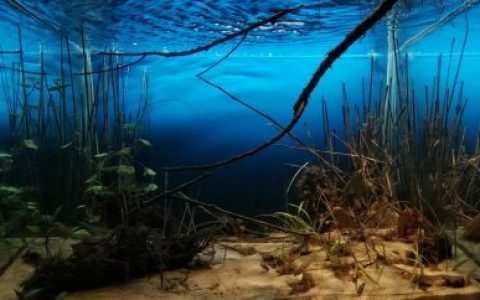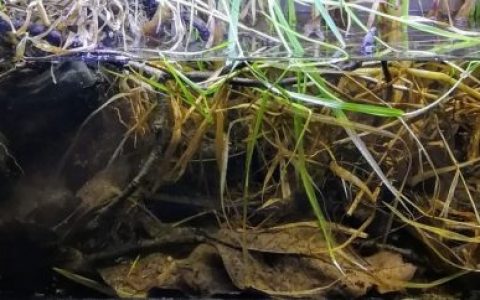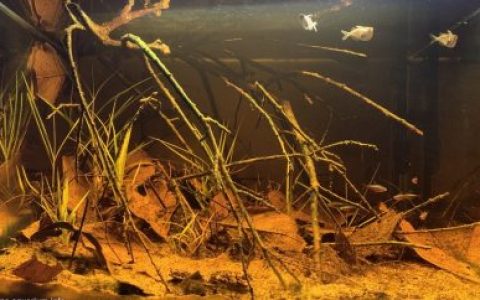
Volume: 112 L 水体容积:112 升
Dimensions: 80x35x40 cm 尺寸:80x35x40 厘米
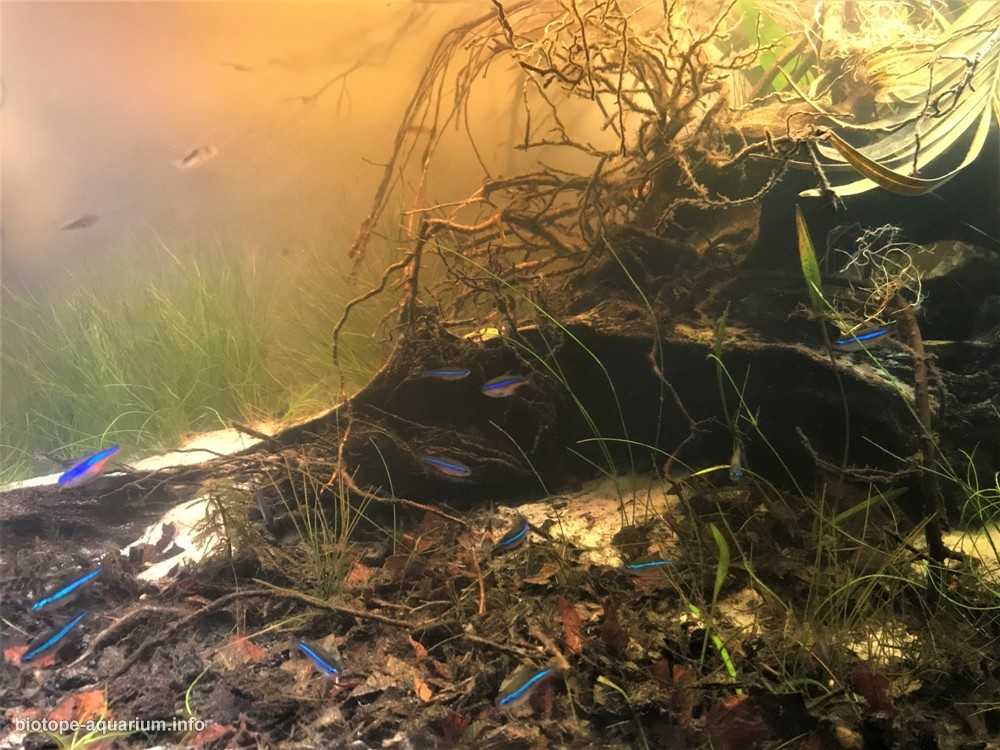
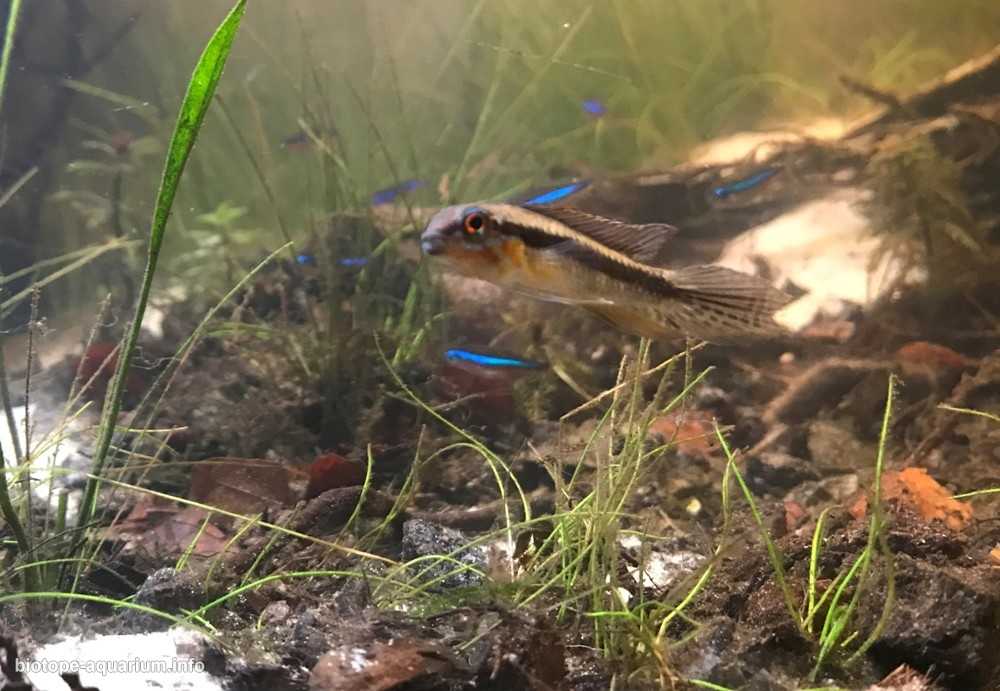
List of fishes: -Apistogramma elizabethae,
鱼类名录:- 阿氏短鲷(Apistogramma elizabethae),
-Corydoras adolfoi, – 阿道夫鼠鱼(Corydoras adolfoi),
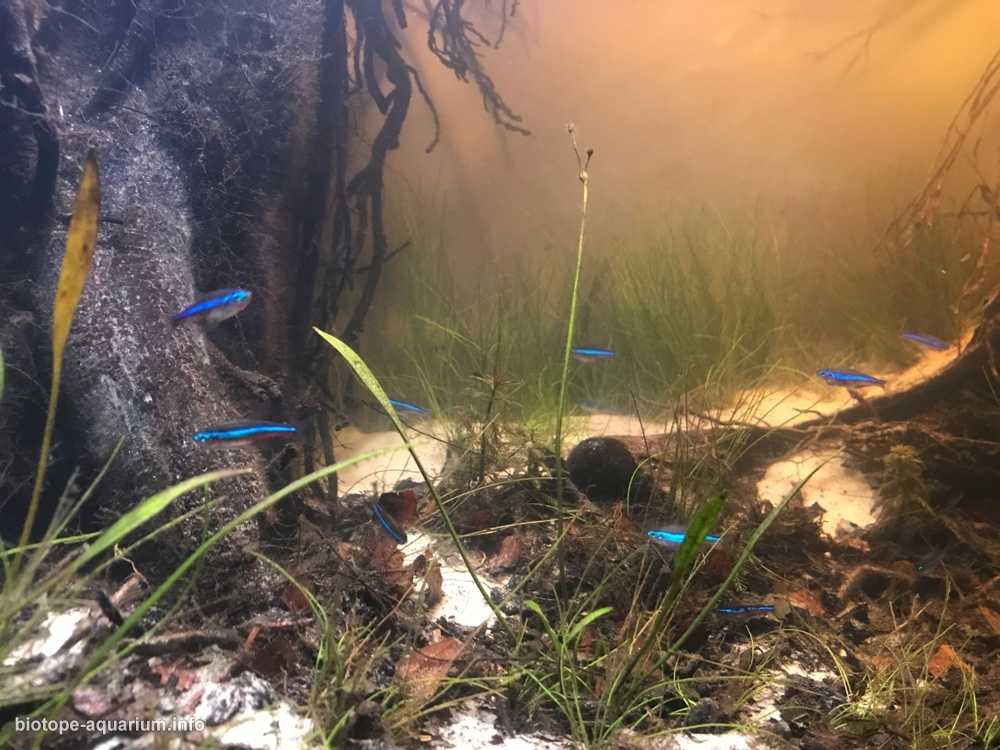
-Paracheitodon simulans,
– 拟霓虹脂鲤(Paracheitodon simulans),
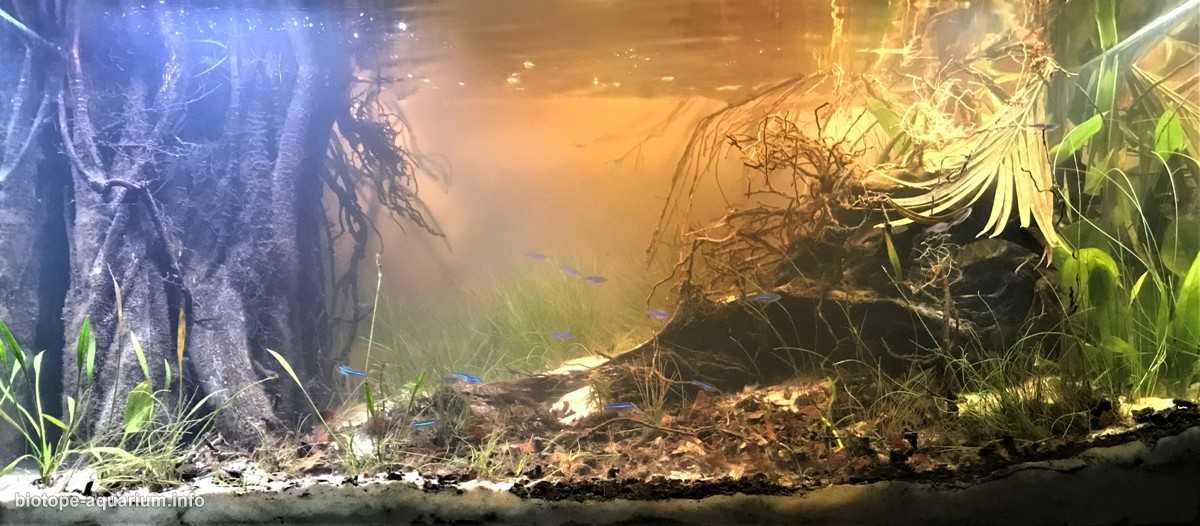
List of plants: Eleocharis acicularis Echinodorus amazonicus Echinodorus sp. Myriophyllum braziliensis Ceratopteris spp.
植物列表:针叶荸荠、亚马逊皇冠草、皇冠草属物种、巴西狐尾藻、水蕨属物种。
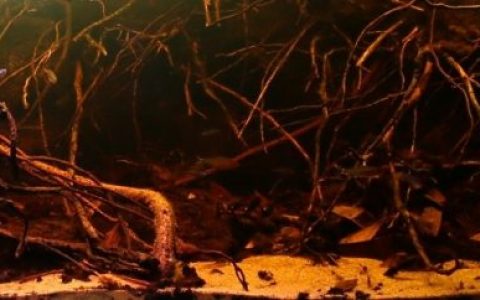
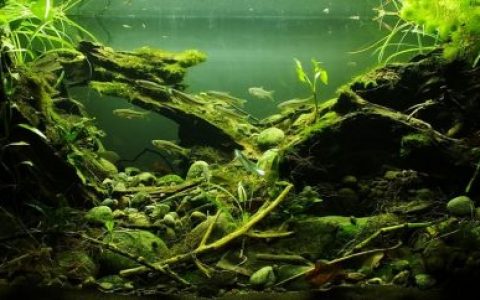
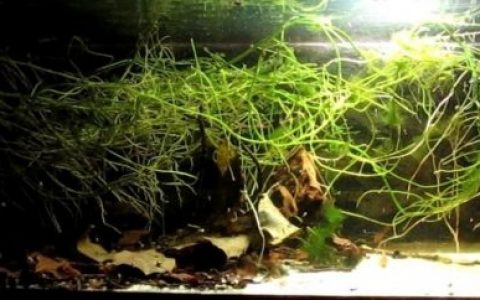
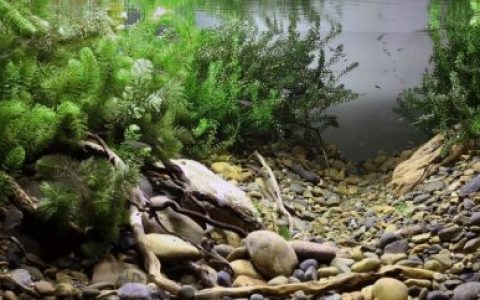
Description of decorations: Well watered driftwood covers the substrate, which is a mixture of sand, clay and fine gravel. Mix of peat, leaves, bark and small branches lays in the parts of tank with small current.
装饰描述:沉木充分覆盖底床,底床由沙子、黏土和细砾石混合而成。泥炭、落叶、树皮和小树枝的混合物放置在鱼缸内水流较缓的区域。
Description of equipment: AQUAEL UNIMAX 250 Lighting:
设备描述:爱酷(AQUAEL)UNIMAX 250 过滤系统;照明:
light color 10000k warm color 3000k
色温 10000K 的冷白光与 3000K 的暖色光。
Water parameters: KH 4, GH 4, pH 6, conductivity 50 μS/cm
水质参数:碳酸盐硬度 4,总硬度 4,pH 6,电导率 50 μS/cm
Additional info: I have already provided all the information in other sections.
INFORMATION ABOUT BIOTOPE
关于生物群落的信息
Description of the area surrounding the biotope: Description of the area surrounding the biotope*
生物栖息地周边区域描述:生物栖息地周边区域描述*
Type locality is ‘affluent of Rio Uaupés at Trovao, about 20 kilometers from mouth of Uaupés, 0°02’N, 67°26’W, Amazonas State, Brazil’.
模式产地为“巴西亚马孙州特罗旺(Trovao)附近乌阿佩斯河(Rio Uaupés)支流,距乌阿佩斯河口约 20 公里,北纬 0°02’,西经 67°26′”。
Rio Vaupés (port of Rio Uaupés) – a river in Brazil and Colombia; main (right) tributary of the Rio Negro river. Rio Vaupés from its sources to the estuary of the River Querary flows through the territory of Colombia (about 845 km). This, to the mouth of the river Papurí, is the border between Brazil and Colombia (about 188 km). From there, to its outlet to the Rio Negro, it flows through Brazil (about 342 km). In its course or Uaupés receives water from other large rivers, such as Tiquié or Papuri, or Querari or Cuduiari.
瓦乌佩斯河(乌阿佩斯河口)——一条流经巴西和哥伦比亚的河流,是内格罗河的主要(右岸)支流。瓦乌佩斯河从源头至克瓦里河河口段流经哥伦比亚境内(约 845 公里)。从该处至帕普里河河口段构成巴西与哥伦比亚的边界(约 188 公里)。此后直至汇入内格罗河的河段则流经巴西境内(约 342 公里)。在其流程中,乌阿佩斯河接纳了多条大型支流的水量,如蒂基耶河、帕普里河、克瓦里河或库杜亚里河。
Description of the underwater landscape of the biotope: In the natural environment, the water is very soft, sour and tinted with tea thanks to tannins. Tannins are in the water due to the large amount of roots lying on the bottom and fallen leaves. The light reaching the bottom is very weak, scattered due to the large number of trees growing on the banks of the river. Sandy bottom, with stones, covered with a thick layer of detritus.
生物群落水下景观描述:在自然环境中,水质极软且呈酸性,因富含单宁而呈现茶色。水底堆积的大量树根与落叶释放出单宁进入水体。由于河岸树木茂密,抵达水底的光线十分微弱且呈散射状。河床为沙质,散布石块,并覆盖着厚厚的碎屑层。
Description of the parameters of the habitat: Parameters of water in the natural environment
栖息地参数描述:自然环境中的水质参数
Soft and sour water. Total hardness 1-4 and pH 5-6, temperature about 25 – 28 degrees conductivity 40 μS /cm. High tannin content.
水质柔软且呈酸性。总硬度 1-4,pH 值 5-6,温度约 25–28 摄氏度,电导率 40 μS/cm。单宁含量较高。
List of fishes and invertebrates occurring in the nature biotope: In Rio Uaupes, a lot of fish species live, for example:
自然生境中出现的鱼类和无脊椎动物名录:在乌阿佩斯河(Rio Uaupes)生活着许多鱼类,例如:
Apistogramma meinkeni, Apistogramma uaupesi, Tucanoichthys tucano, Nannostomus spp., Corydoras imitator, Corydoras adolfoi, Ivanacara adoketa, Paracheitodon simulans.
阿氏短鲷(Apistogramma meinkeni)、乌阿佩斯短鲷(Apistogramma uaupesi)、图卡诺鱼(Tucanoichthys tucano)、霓虹脂鲤属(Nannostomus spp.)、拟美鼠鱼(Corydoras imitator)、阿道夫鼠鱼(Corydoras adolfoi)、伊万卡拉慈鲷(Ivanacara adoketa)、拟帕拉切顿鱼(Paracheitodon simulans)。
List of plants found in the nature biotope: Due to the prevailing conditions, there are few plants in the river. There are places where plants are more. There are, among others:
自然生境中发现的植物名录:由于环境条件所限,河中植物较少,但在某些区域植物较为丰富,其中包括:
Eleocharis acicularis, Echinodorus amazonicus, Echinodorus sp., Myriophyllum braziliensis, Ceratopteris spp., Eichhornia crassipes
针叶荸荠(Eleocharis acicularis)、亚马逊皇冠草(Echinodorus amazonicus)、皇冠草属(Echinodorus sp.)、巴西狐尾藻(Myriophyllum braziliensis)、水蕨属(Ceratopteris spp.)、凤眼莲(Eichhornia crassipes)。
Threats to the ecology: The Uaupes, a tributary of the Rio Negro, is a blackwater river. The ecology of blackwater rivers differs from temperate aquatic systems. In temperate climates, the base of the food chain is usually micro flora, produced by photosynthetic and chemosynthetic action on nutrients in the water. Early researchers were faced with the apparent paradox that many Amazonian rivers, while containing both low levels of nutrients and low in situ production of primary phytoplankton, nonetheless support flourishing fish populations. Food supplies in blackwater rivers come from external sources. River margins provide food for fish – vegetable matter such as leaves, fruits, flowers, seeds, and microflora, and numerous animal forms such as insects, insect larvae, arachnids, crustaceans, and worms. This food enters the river as floating and decomposed matter and mud. Water levels fluctuate with seasonal rain. When flooding peaks , waters overspill their banks merging aquatic and terrestrial zones, and allowing fish into the flooded forests to feed. Some of the fish populations of these rivers have evolved to exploit increased numbers of foods available during floods and to store these energy reserves as fatty deposits. Uaupes soils, podsols and latosols, are eroded from the ancient Guyana Shield through which the Uaupes River flows. These soil types are typical of blackwater areas.Podsols result from intense weathering of soils in a strongly acid medium. Leaching removes soluble minerals leaving the soil high in aluminum and iron compounds. The unweathered surface material is a white sand, devoid of important nutrients such as nitrogen and phosphorous. Latosols are weathered soils rich in iron. When exposed to repeated drying and moistening, the iron segregates, forming nodules and concretions which cement to a rock-like hardness known as laterite. These soils’ principal source of nutrients is derived from the accumulation of leaf fall and other debris from the forest. Upon clearing, nutrients are quickly eroded. Thus, to remove the forest cover is to remove the nutrients of both the terrestrial and aquatic systems. Without the leaf litter from the forest, the soils become either white sands or brick-like laterites, both inhospitable to agriculture. Finally, were the forest margin to be denuded for agriculture, these soils would quickly erode, altering the river channel and depositing silt in the river. Agriculture is a short-lived phenomenon in deforested blackwater regions because nutrient supply is quickly exhausted. Greater protein yields per hectare from blackwater areas are obtained by maintaining the forest as a grazing ground for fish.
生态面临的威胁:乌阿佩斯河是内格罗河的支流,属于黑水河。黑水河的生态系统与温带水生系统存在差异。在温带气候区,食物链的基础通常是微生物群落,它们通过光合作用和化能合成作用利用水中的营养物质生成。早期研究者曾面临一个明显的悖论:许多亚马逊河流虽然营养物质含量低、原位初级浮游植物生产力也低,却仍能支撑繁盛的鱼类种群。黑水河的食物供应来自外部来源。河岸为鱼类提供食物——包括树叶、果实、花朵、种子和微生物等植物性物质,以及昆虫、昆虫幼虫、蛛形纲动物、甲壳类动物和蠕虫等多种动物形态。这些食物以漂浮物、分解物和淤泥的形式进入河流。水位随季节性降雨而波动。当洪水达到峰值时,河水漫溢河岸,使水域与陆地区域相互连通,让鱼类得以进入被淹没的森林觅食。 这些河流中的部分鱼类种群已进化出利用洪水期间增多的食物资源的能力,并将这些能量以脂肪沉积的形式储存起来。乌阿佩斯河所流经的古老圭亚那地盾被侵蚀,形成了该地区的土壤类型——灰化土和砖红壤。这些土壤类型是黑水区域的典型特征。灰化土是在强酸性介质中土壤经历强烈风化而形成的。淋溶作用带走了可溶性矿物质,使土壤中富含铝和铁的化合物。未风化的表层物质为白色沙子,缺乏氮和磷等重要营养元素。砖红壤则是富含铁的风化土壤。当反复经历干燥与湿润过程时,铁会发生分离,形成结核和胶结物,最终固结成具有岩石般硬度的层状结构,称为红土。这些土壤的主要营养来源依赖于森林落叶及其他碎屑的积累。一旦森林被砍伐,营养物质便会迅速流失。因此,移除森林覆盖等同于同时剥夺了陆地和水生系统的营养基础。 若没有森林的枯枝落叶层,土壤将退化为白沙或砖状红土,两者均不利于农业耕作。最后,若为开垦农田而砍伐森林边缘,这些土壤会迅速遭受侵蚀,改变河道形态并在河中沉积淤泥。在黑水河区域的毁林地带,农业只能是昙花一现,因为养分供给会很快耗尽。相比之下,将黑水河区域的森林保留作为鱼类的天然觅食场,每公顷可获得更高的蛋白质产量。
One can clearly see how the soil layer of fertile soil in the Amazon is unstable and how little it needs to be degraded. Tribes living in this area cultivate to a very limited extent, therefore their impact on the environment is small. Much worse results are caused by a lumbering timber economy, which by cutting trees in huge areas causes soil sterilization by removing a thin layer of humus. In the place of the cut forest, nature is reborn very slowly.
人们可以清楚地看到,亚马逊地区肥沃的表土层极不稳定,只需轻微破坏便会退化。生活在此区域的部落仅进行极为有限的耕作,因此对环境的影响微乎其微。更为严重的后果则源于以木材采伐为主的经济模式:大规模砍伐树木会移除薄薄的腐殖质层,导致土壤彻底丧失肥力。在被砍伐的森林原址上,自然生态的恢复过程极其缓慢。
A separate threat to this region is the legal and illegal exploration of raw materials. When extracting, for example, gold, mercury or cyanide is used. The waste after the recovery of gold goes very often directly to smaller and larger rivers, causing mass poisoning of fish and other aquatic animals. This creates a huge threat to the people living in this area. It is very common to use violence against the Indians, and even murders of some tribesmen to intimidate others
对该地区的另一项威胁是原材料的合法与非法开采。例如,在开采黄金时,会使用汞或氰化物。提金后产生的废料常常直接排入大小河流,导致鱼类及其他水生动物大规模中毒。这对生活在该地区的人们构成了巨大威胁。针对印第安人的暴力行为十分普遍,甚至会发生杀害部分部落成员以恐吓他人的事件。
本文部分素材来自网络,如有类似请联系修改,如若转载,请注明出处:http://www.yangyubang.com/?p=3193