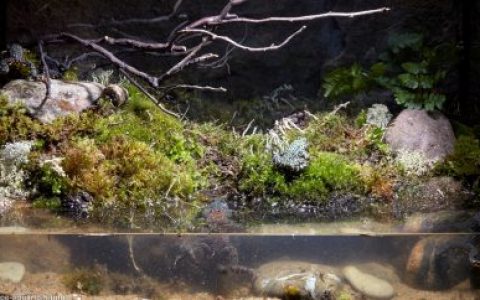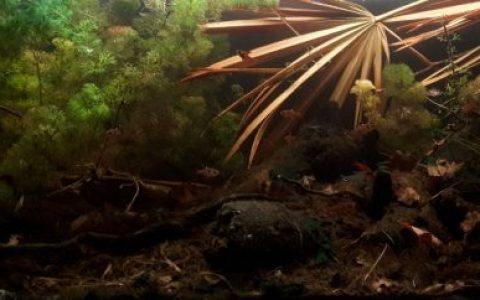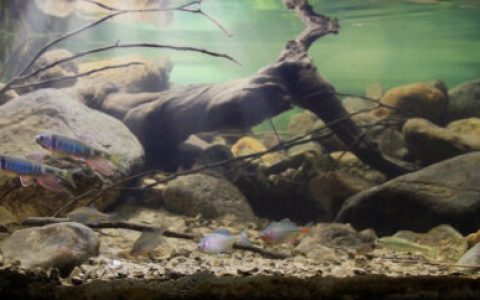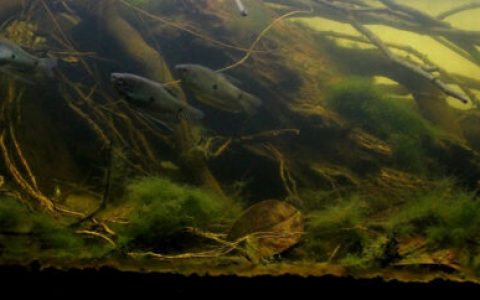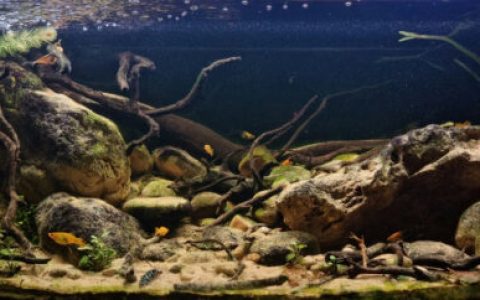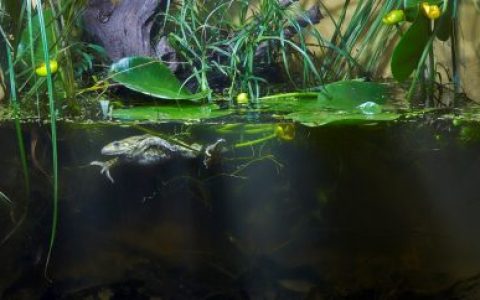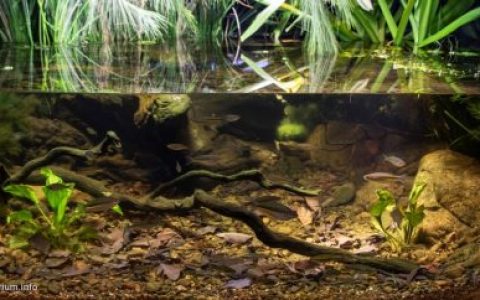
Volume: 50 L 容积:50 升
Dimensions: 40x40x35 cm 尺寸:40×40×35 厘米
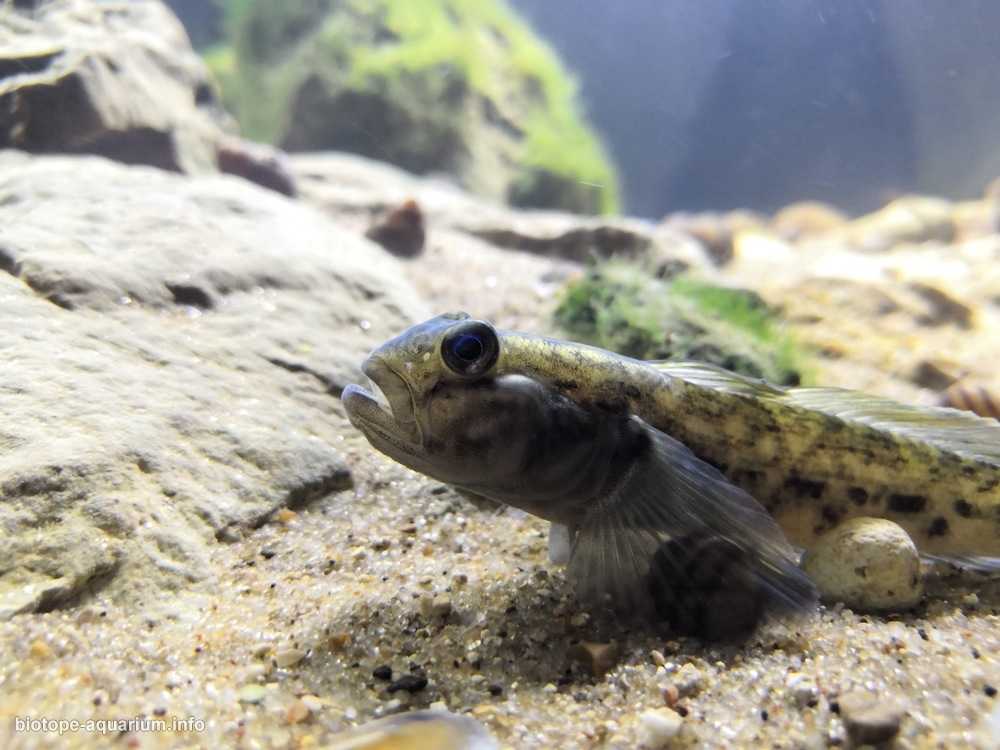
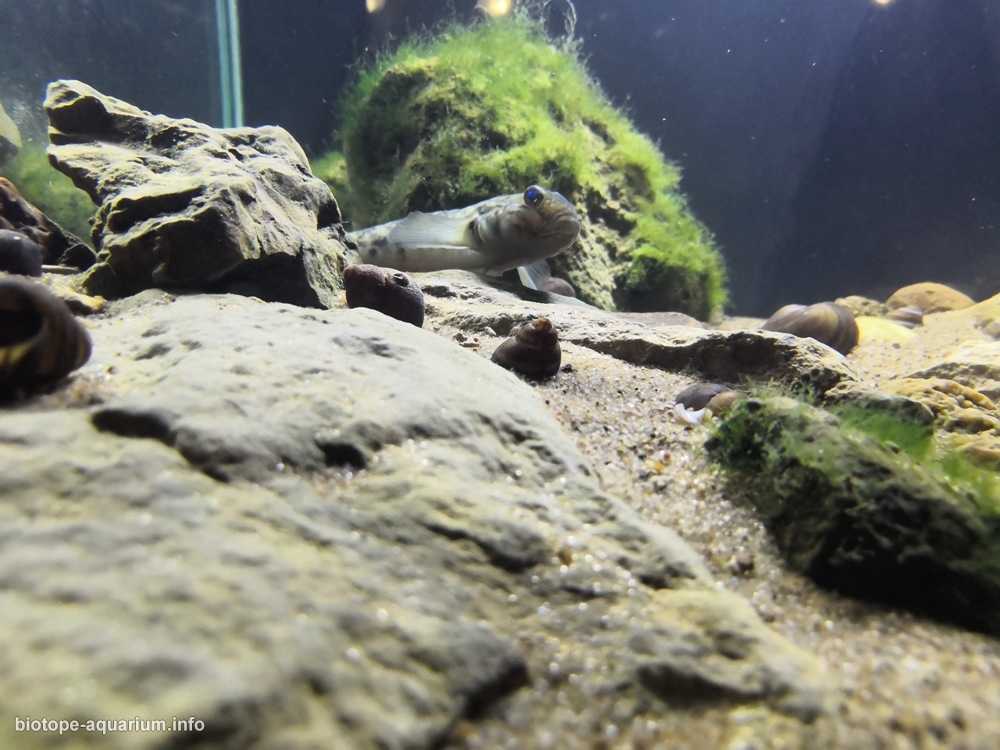
List of fishes: Neogobius melanostomus , Amphipoda .
鱼类名录:黑虾虎鱼(Neogobius melanostomus)、端足类(Amphipoda)。
List of plants: Ulothrix zonata
植物列表:带状石莼(Ulothrix zonata)
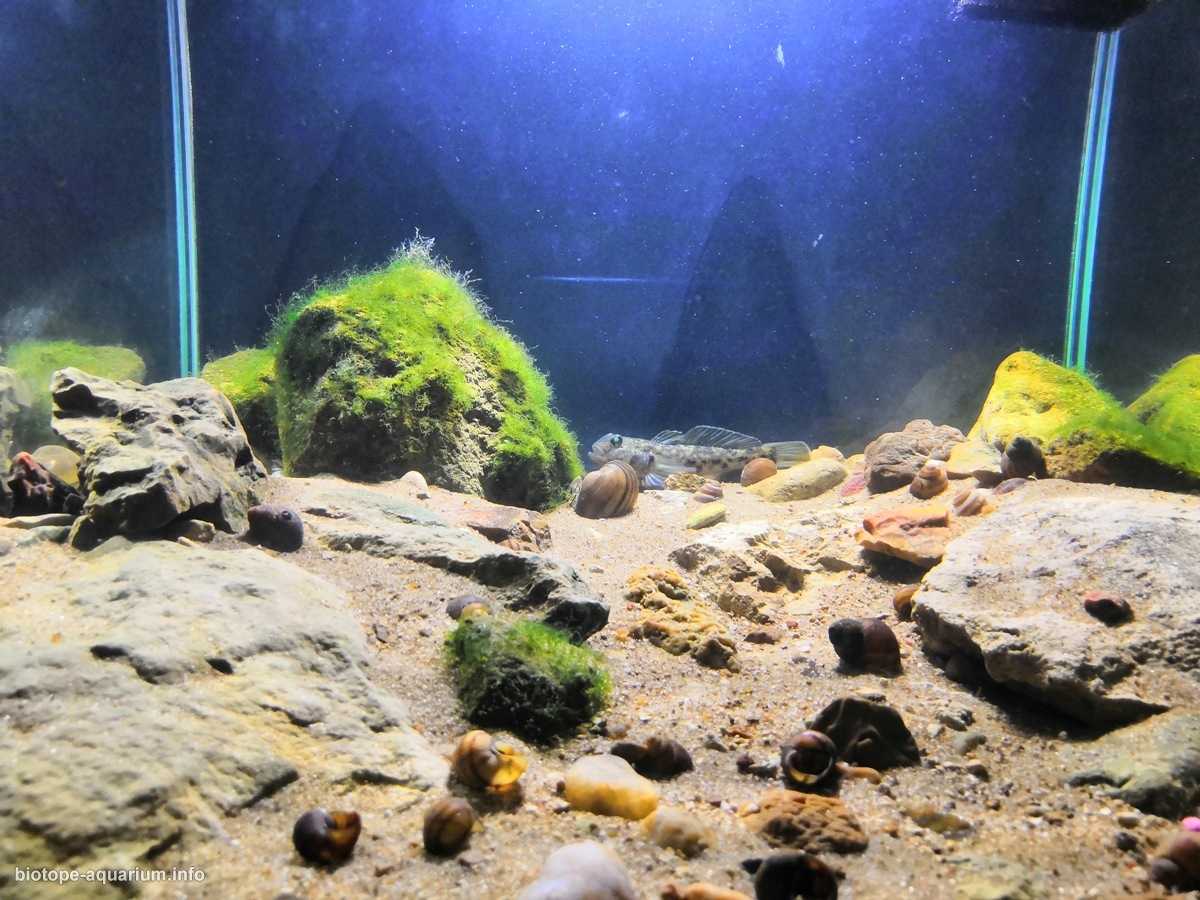
Description of decorations: Stones are silicon, quartz, feldspar, small fragments of red granite, large limestone. The sand is gray and yellow, grains of different sizes up to 1mm. A crumb of all the stones listed, as well as small fragments of shells. Shells of snails and freshwater mussels. Tree branches that grow along a river, such as willow and sea buckthorn. All materials are taken from the Oka River and adapted to simulate the natural environment.
装饰描述:石材包括硅质岩、石英、长石、红色花岗岩的小碎片以及大块石灰岩。沙子呈灰色和黄色,颗粒大小不一,最大达 1 毫米。此外还含有上述各类石材的碎屑以及贝壳的小碎片,包括螺类和淡水蚌类的壳。沿河生长的树枝,如柳树和沙棘枝。所有材料均取自奥卡河,并经过处理以模拟自然环境。
Description of equipment: The aquarium has an internal Tetra Filter Jet 400 (400 l / h). The flow is directed upward so that waves are created on the surface of the water. The AC220V 5W 12 LED lamp is LED.
设备描述:水族箱配备一台内置式 Tetra Filter Jet 400 过滤器(流量 400 升/小时)。水流方向朝上,以便在水面形成波浪。照明采用一盏交流 220V、5W、含 12 颗灯珠的 LED 灯。
Water parameters: Water temperature 23 ° C; PH 8.1; PO4 0.25; GH 10. Water parameters is achieved thanks to the scenery taken from the river itself. Light suspension in water due to the circulation of water and the activity of the inhabitants of the aquarium, which corresponds to the natural environment.
水质参数:水温 23°C;pH 值 8.1;磷酸盐(PO4)0.25;总硬度(GH)10。这些水质参数得益于直接从河流中取材的造景布置。由于水体循环及水族箱内生物的活动,水中存在轻微悬浮物,这与自然环境相符。
INFORMATION ABOUT BIOTOPE
关于生物群落的信息
Description of the area surrounding the biotope: The Oka River originates from a spring in the village of Aleksandrovka, Glazunovsky District, Oryol Region, at an altitude of more than 221 m above sea level. It passes along the Central Russian Upland.
生物群落周边区域描述:奥卡河发源于奥廖尔州格拉祖诺夫斯基区亚历山德罗夫卡村的一处泉眼,海拔超过 221 米。它流经中央俄罗斯高地。
At first it flows northward, merges with Orlik in Orel, merges with Upa in the Tula region, merges with Ugra near Kaluga and merges sharply east, and after flowing through Aleksin and Tarusa, it turns north again, then it turns east again near the town of Protvino. Near the city of Kolomna it merges with the Moskva River and further, making a bend 10 km east of Lukhovitsy, flows southeast to Ryazan. In the Ryazan region, due to the hilly areas near the Oka, tortuosity is observed. Near the confluence with the Pronea Oka, making a bend, it turns to the right, and after merging with the Para it flows north again, making a large bend near Kasimov. Moksha flows into the Oka River below the territory of the Yermishinsky District, and the Unzha River flows into the territory of the Kasimovsky District. Then it flows with bends, separating the Vladimir and Nizhny Novgorod regions, where it flows through Murom, Pavlovo, Dzerzhinsk. The river at the end of its journey with a length of almost 1,500 kilometers forms a floodplain 2,500 meters wide and flows into the longest and largest river in Russia: the Volga. The height of the mouth is 64 m above sea level. The river has more than 150 tributaries. The catchment area is 245 thousand km². Sometimes, its width is at least 2.5 km. The length in the Moscow region is 176 kilometers. The shores are mainly sandy and clay, overgrown with pine forests. In the city of Kolomna (Latitude, longitude: 55.0794, 38.7783 Altitude: 143 meters), the coast is rocky, except for the beach. The width of the river is up to 200 meters more often 120-130
它最初向北流淌,在奥廖尔与奥尔利克河汇合,在图拉州与乌帕河汇合,在卡卢加附近与乌格拉河汇合,随后急剧转向东流;流经阿列克辛和塔鲁萨后,再次折向北行,而后在普罗特维诺镇附近又转向东流。在科洛姆纳市附近,它与莫斯科河汇合,继续前行,在卢霍维齐以东 10 公里处形成一个河弯,继而向东南流向梁赞。在梁赞州境内,由于奥卡河沿岸多丘陵地带,河道蜿蜒曲折。在与普罗尼亚河汇合处附近,奥卡河形成一个河弯后向右转折,与帕拉河汇合后再次向北流淌,并在卡西莫夫附近形成一个巨大的河弯。莫克沙河在叶尔米申区辖境以下注入奥卡河,而温扎河则流入卡西莫夫区辖境。此后,河道蜿蜒前行,成为弗拉基米尔州与下诺夫哥罗德州的界河,流经穆罗姆、帕夫洛沃和捷尔任斯克。这条全长近 1,500 公里的河流在其终点形成宽达 2,500 米的洪泛平原,最终汇入俄罗斯最长、最大的河流——伏尔加河。河口海拔高度为海平面以上 64 米。 该河拥有超过 150 条支流,流域面积达 24.5 万平方公里。其宽度有时至少可达 2.5 公里,在莫斯科州境内的长度为 176 公里。河岸主要由沙土和黏土构成,并覆盖着松林。在科洛姆纳市(纬度 55.0794,经度 38.7783,海拔 143 米),除沙滩外,海岸多为岩石质地。该河宽度通常可达 200 米,更常见的是 120 至 130 米。
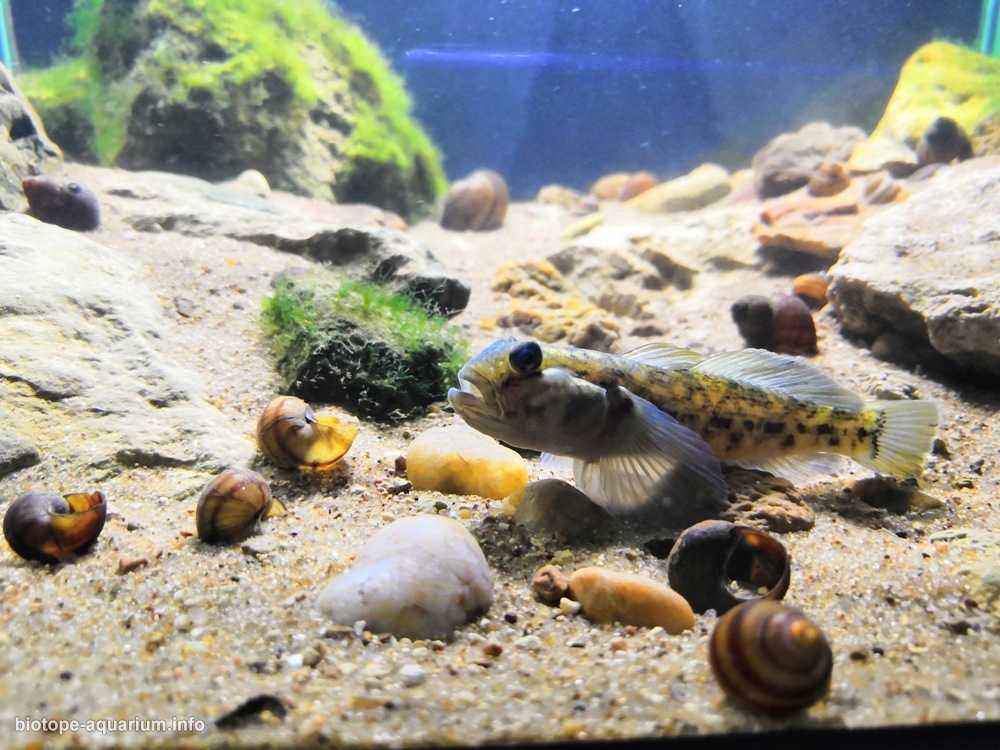
Description of the underwater landscape of the biotope: The landscape of the Oka is diverse, due to its large extent. The area of the Oka shown in the biotope aquarium has a sandy bottom covered with stones. The sand is mixed, gray and yellow. Sand grains of different sizes up to 1mm. Under the sand there is silt. Along the coast a large amount of limestone from small stones to blocks of several meters. Silicon, quartz, feldspar and red granite are also present in large numbers. Some of the stones are covered with threadlike algal fouling, which are randomly located along the riverbank. Empty sand shells of snails and a small number of shells of freshwater mussels are often found in the sand between the stones. There are no large snags and tree branches growing along the river. The current carries them to the backwaters, but small fragments of fallen parts, a little submerged in the sand, are sometimes found.
生物群落的水下景观描述:奥卡河的水下景观因其流域广阔而呈现多样性。该生物群落水族箱所展现的奥卡河区域,拥有被石块覆盖的沙质河床。沙子呈灰黄相间的混合色,沙粒大小不一,最大可达 1 毫米。沙层下方为淤泥。沿岸分布着大量石灰岩,从小石块到数米大的岩块均有。此外,硅石、石英、长石和红色花岗岩也大量存在。部分石块表面附着丝状藻类污垢,这些石块沿河岸随机分布。在石块之间的沙地上,常可发现空的螺壳以及少量淡水蚌壳。沿河生长的大型沉木和树枝在此处并不存在;水流将它们冲至回水区,但偶尔仍能在沙中见到少许半埋的小型断裂残片。
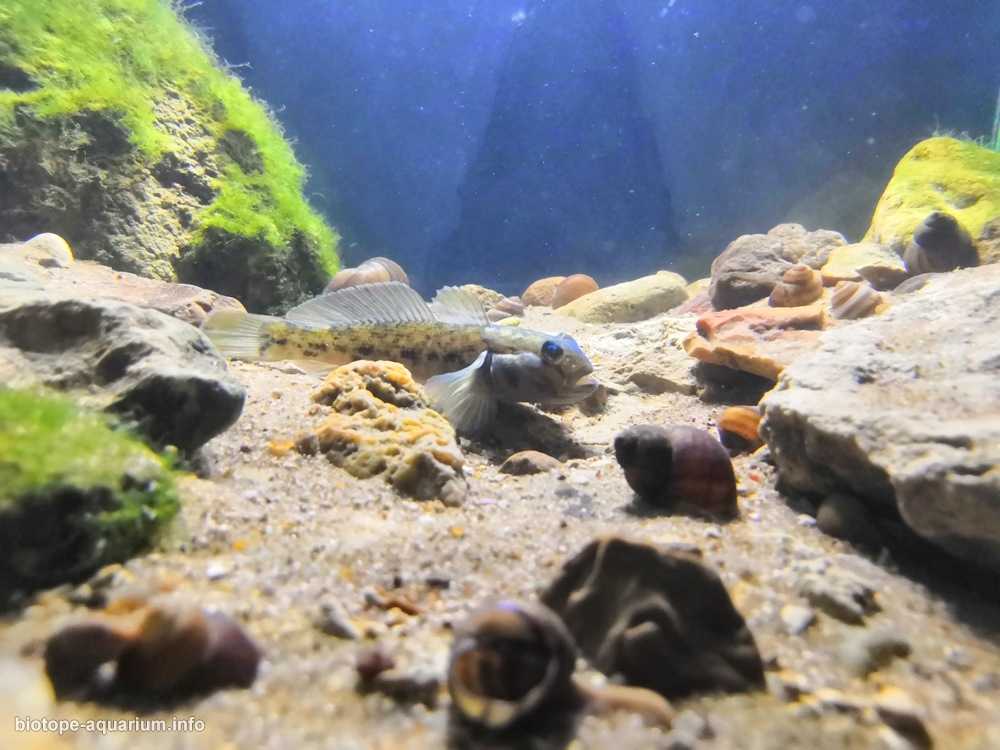
Description of the parameters of the habitat: Water in the Oka has a subtle green hue. Along the coast in the water there is a light suspension from small particles of silt, which is formed from waves. The water temperature at this time of year (summer) ranges from 18 to 23 ° C. In autumn, winter and spring, the water temperature is much lower. The temperature of the water and its indicators were measured personally and I do not use any source. PH 8 – 8.3. PO4 0.25; Gh 10
栖息地参数描述:奥卡河的水呈现出淡淡的绿色调。沿岸水域中因波浪作用而悬浮着由细小淤泥颗粒形成的轻微浑浊物。此时(夏季)水温介于 18 至 23 °C 之间;秋季、冬季和春季的水温则显著更低。水温及其各项指标均为本人亲自测量,未引用任何外部来源。pH 值为 8–8.3,磷酸盐(PO4)浓度为 0.25,总硬度(Gh)为 10。
List of fishes and invertebrates occurring in the nature biotope: The basis of the Oka fish herd are:
自然生境中出现的鱼类与无脊椎动物名录:奥卡河鱼类群落的基础物种包括:
bream (Abramis brama), 欧鳊(Abramis brama),
roach (Rutilus rutilus) 赤眼鳟(Rutilus rutilus)
Gustera (Blicca bjoerkna).
拟鲤(Blicca bjoerkna)。
The sterlet (Acipenser ruthenus) is rare
小体鲟(Acipenser ruthenus)较为罕见。
Also in the Oka lives:
奥卡河中还有:
asp (aspius aspius) 雅罗鱼(aspius aspius)
white eye (Abramis sapa)
白目鱼(Abramis sapa)
gold and silver carp (Carassius carassius and carassius auratus gibelio)
金鲫和银鲫(Carassius carassius 和 Carassius auratus gibelio)
tench (tinca tinca) 丁鱥(Tinca tinca)
bitterling (Rhodeus sericeus)
鳑鲏(Rhodeus sericeus)
Chekhon (Pelecus cultratus)
拟鲤(刀鲚)
rudd (Scardinius erytrophtalmus)
红眼鱼(赤睛鱼)
bleak (Alburnus albyrnus)
白鱼(欧白鱼)
perch (Perca fluviatilis)
河鲈(欧洲河鲈)
zander (Lucioperca lucioperca)
梭鲈(Lucioperca lucioperca)
Bersh (Lucioperca volgensis)
伏尔加梭鲈(Lucioperca volgensis)
ruff (Acerina cernua) 梅花鲈(Acerina cernua)
pike (Esox lucius) 狗鱼(Esox lucius)
burbot (Lota lota) 江鳕(Lota lota)
catfish (Silurus glanis)
鲶鱼(Silurus glanis)
loach (Misgurnus fossilis)
泥鳅(Misgurnus fossilis)
plucking (Cobitis taenia)
花鳅(Cobitis taenia)
char (noemacheilus barbatulus)
花鳅(Noemacheilus barbatulus)
The sculpin (Cottus gobio), a representative of the family of sculpin gobies (Cottidae), is hiding under the stones under the stones. In the pool, the Oka appeared by chance and took root. They include the round goby Neogobius melanostomus – a brackish-water species whose initial range covers the Caspian, Azov and Black Seas. One of the possible ways for the round goby to enter the Moscow River, and later the Oka, could be the transfer of clutch laying on the bottoms of ships.
杜父鱼(Cottus gobio),属于杜父鱼科(Cottidae)的代表物种,正躲藏在石块之下。在奥卡河的水潭中,它们偶然出现并在此扎根。其中包括圆虾虎鱼(Neogobius melanostomus)——一种半咸水物种,其原始分布范围涵盖里海、亚速海和黑海。圆虾虎鱼进入莫斯科河,随后扩散至奥卡河的可能途径之一,是附着于船舶底部的卵块被转移。
Invertebrates: 无脊椎动物:
Crayfish (Latin: Astacus fluviatilis)
螯虾(学名:Astacus fluviatilis)
Viviparus viviparus L., Paludina vivipara
尖口圆扁螺(Viviparus viviparus L.),亦称河螺(Paludina vivipara)
Unio pictorum 画师无齿蚌(Unio pictorum)
Dragonfly larvae of the rocker-dragonfly type:
蜓科类型的蜻蜓幼虫:
Aeschna grandis, Aeschna cyanea and Aeschna viridls.
大蜓(Aeschna grandis)、蓝蜓(Aeschna cyanea)和绿蜓(Aeschna viridls)。
and other species. 及其他物种。
List of plants found in the nature biotope: The following plants are often found in the Oka River
奥卡河自然生境中的植物名录:以下植物常见于奥卡河
● Potamogeton lucens ● 光叶眼子菜
● Potamogeton angustifolius
● 窄叶眼子菜
● Potamogéton críspus ● 波状眼子菜
● Stratiótes aloídes ● 水蕴草
● Ceratophýllum ● 金鱼藻
● núphar lútea ● 黄睡莲
● Hydrocharis ● 水鳖
● Lémna ● 浮萍
● Scírpus ● 藨草属
● Glycéria ● 甜茅属
● Sagittaria sagittifolia
● 慈姑(Sagittaria sagittifolia)
In the Oka, you can find a number of other less common plants. In some areas of the reservoir, there are no plants at all, as is the case with the area in which this biotope was created.
在奥卡河中,还可以发现许多其他较为罕见的植物。在水库的某些区域则完全没有任何植物,本生物缸所模拟的区域便是如此。
Threats to the ecology: In the suburbs, the most serious situation is developing on the Oka River, which stretches across the territory of the region. In recent years, the Hydrometeorological Center notes that the Oka has become shallow due to unregulated channel mining of sand, which lasted several decades. Mining accelerates the process of subsidence of the coastline and river bottom. The bottom is changing, somewhere in the middle of the river the same depth may remain, but at the same time the level of the river relative to the coast decreases. The shallowing of the Oka affects the reduction in the population of fish and its other inhabitants.
生态威胁:在郊区,最严峻的局势正发生在横贯该区域的奥卡河上。近年来,水文气象中心指出,由于长达数十年的无序河道采砂活动,奥卡河水位变浅。采砂加速了河岸与河床的下沉过程。河床形态正在改变:河流中段某些区域的水深可能保持不变,但与此同时,相对于河岸的河面水位却在下降。奥卡河的变浅导致鱼类及其他水生生物的数量减少。
本文部分素材来自网络,如有类似请联系修改,如若转载,请注明出处:http://www.yangyubang.com/?p=2993