Volume: 600 L 水体容积:600 升
Dimensions: Corner aquarium 600L, with one side longer 120x65h, 95x65h, front is 100x65h. The aquarium is turned so that the 120 cm long side is a panorama, that is, the front.
尺寸:转角水族箱,容量 600 升,其中一侧较长,尺寸分别为 120×65 厘米(高)、95×65 厘米(高),正面为 100×65 厘米(高)。水族箱的摆放方式使 120 厘米长的一侧作为全景面,即正面。
List of fishes: Paretroplus dambabe, Pelomedusa surbufa.
鱼类名录:帕雷特罗普卢斯·丹巴贝鱼(Paretroplus dambabe)、苏尔布法侧颈龟(Pelomedusa surbufa)。
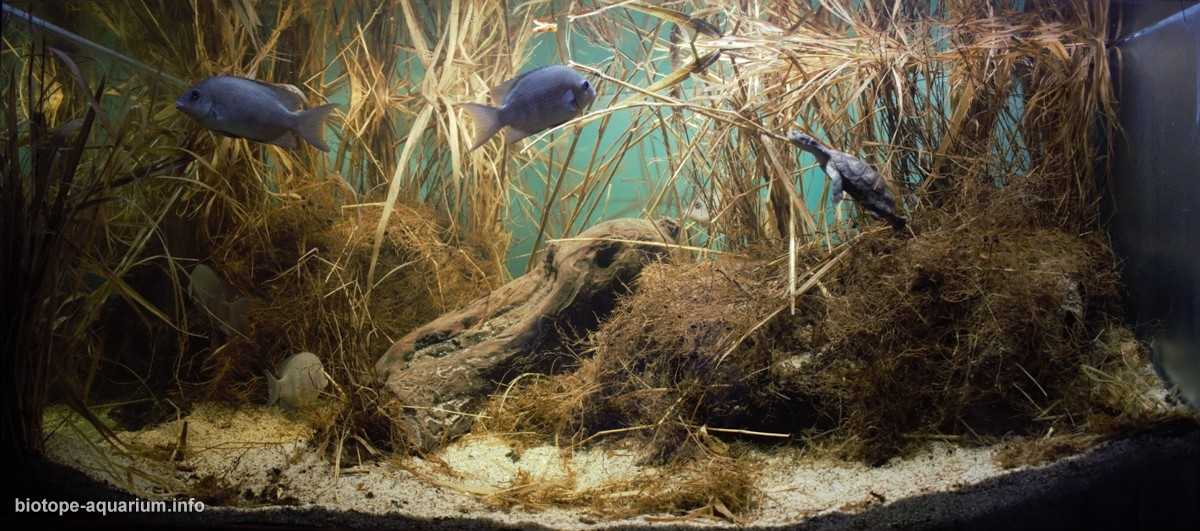
List of plants: Dry reed Phragmites sp.
植物清单:旱芦苇(Phragmites sp.)
Description of decorations: Substrate: Bright sand mix 0.4-1.2mm.
装饰描述:底床:0.4–1.2 毫米的浅色混合沙。
Description of equipment: Filtration: JBL CristalProfi e1901 greenline — 1900l / h bucket capacity 15l divided into 5 baskets with media, one is a protective sponge, the other four is a biology divided between, Jbl Micromec balls and good quality sintered glass (ceramics). Circulation: Cascade filter Seachem Tidal 110 — 2000l / h with built-in water surface skimmer. Filter media is one sponge and matrix. Heating: Two Eheim Jager 200W heaters connected together to the STC-1000 precision thermostat
设备描述:过滤系统:JBL CristalProfi e1901 greenline,流量 1900 升/小时,桶容量 15 升,分为 5 个滤篮并填充滤材;其中一个为保护海绵,其余四个用于生物过滤,填充物包括 Jbl Micromec 滤球和优质烧结玻璃(陶瓷)。水流循环:Seachem Tidal 110 瀑布式过滤器,流量 2000 升/小时,内置水面撇渣器;滤材为一块海绵和 Matrix 滤材。加热系统:两台 Eheim Jager 200W 加热棒并联连接至 STC-1000 精密温控器。
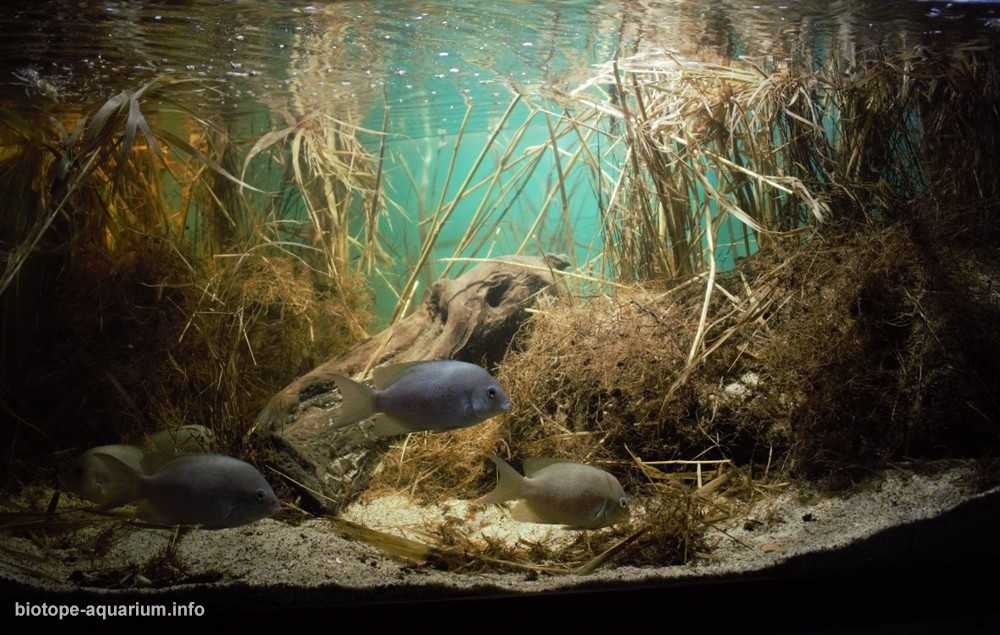
Light: The basic lighting is Aquatlantis Easy LED Freshwater, 1047mm, 6800 ° K-52w with EASY LED CONTROL, a simulator of the effects of sunrise and sunset. In addition, the lamp 6000 ° K-16w, led lamp 4000 ° K-10w and it has two tasks, to illuminate the left rear, but mainly warm Heniek (turtle) on his islet from plexiglass (I did not see that he used it) I suppose that the water is warm enough. I will briefly describe my experience with RGB LEDs used to give the background color. Ultimately, it was a background with glued matte foil to the outer pane, which allowed to achieve the effect of smudged depth. It consisted in raising the main lighting by 50 cm and placing the material in the chosen color for the aquarium, which, being illuminated, gives us great depth. And so it happened, I was very happy with the result, also putting a dry reed behind the aquarium. Watching similar solutions on the net, I came across a patent using RGB LEDs, and decided to try with a 40cm strap, I glued it from the top, above the water. The effect was amazing, the colors shaded by the pilot, I admit that they look very green, blue and their shades, I also think that yellow will work in BW biotopes and similar. All you need is a little space for the aquarium and a white background to which we direct the LEDs.
照明:基础照明采用配备 EASY LED CONTROL 的 Aquatlantis Easy LED 淡水灯,规格为 1047 毫米、6800 K、52 瓦,可模拟日出与日落效果。此外,还加装了一盏 6000 K、16 瓦的灯具和一盏 4000 K、10 瓦的 LED 灯;后者承担两项任务:照亮左后区域,并主要为海尼克(乌龟)在其有机玻璃小岛上提供取暖(我并未见它使用过),想必水温已足够温暖。在此简要分享我使用 RGB LED 营造背景色彩的经验。最终方案是在外侧玻璃上粘贴磨砂膜,从而营造出朦胧深邃的视觉效果。具体做法是将主照明抬高 50 厘米,并在鱼缸后方布置选定颜色的材料,经光照后呈现出极佳的纵深感。效果果然如愿,令我十分满意;我还在鱼缸后方放置了干枯的芦苇。在网络上浏览类似方案时,我偶然发现一项利用 RGB LED 的专利设计,于是决定尝试:我将一条 40 厘米长的 LED 灯带从上方粘贴于水面之上。 效果令人惊叹,由灯光营造出的色彩层次分明;我承认它们看起来非常绿、蓝且富有层次感,我也认为黄色在黑白风格生物缸及类似场景中会很出彩。您只需为水族箱预留一点空间,并设置一个白色背景板,将 LED 灯朝向它照射即可。
Water parameters: Ph 7.5, Gh14, Kh7, Temperature 28°C
水质参数:pH 7.5,GH 14,KH 7,温度 28°C
Additional info: Tank service: Due to the high organic content, water changes are 50% every 10 days, frequent refills, feeding takes place 4 times a day with JBL AutoFood, Heńiek and fish are often given in the form of mussels, shrimps, etc.
补充信息:鱼缸维护:由于有机质含量较高,每 10 天换水 50%,并频繁补水;每日使用 JBL AutoFood 自动喂食器投喂 4 次,此外还经常以贻贝、虾等形式投喂活饵或冷冻饵料。
INFORMATION ABOUT BIOTOPE
关于生物群落的信息
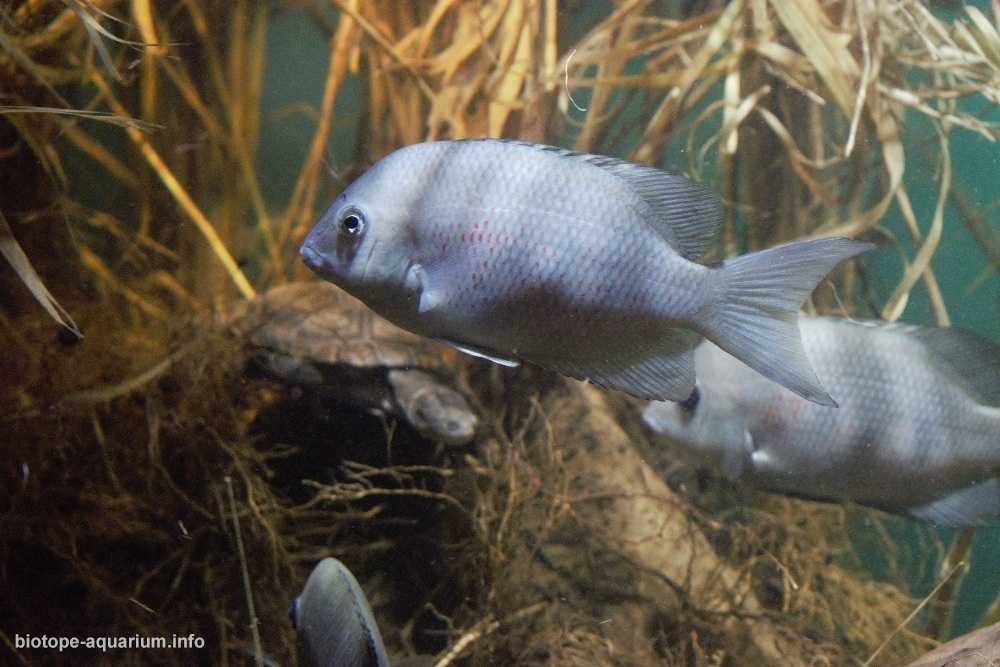
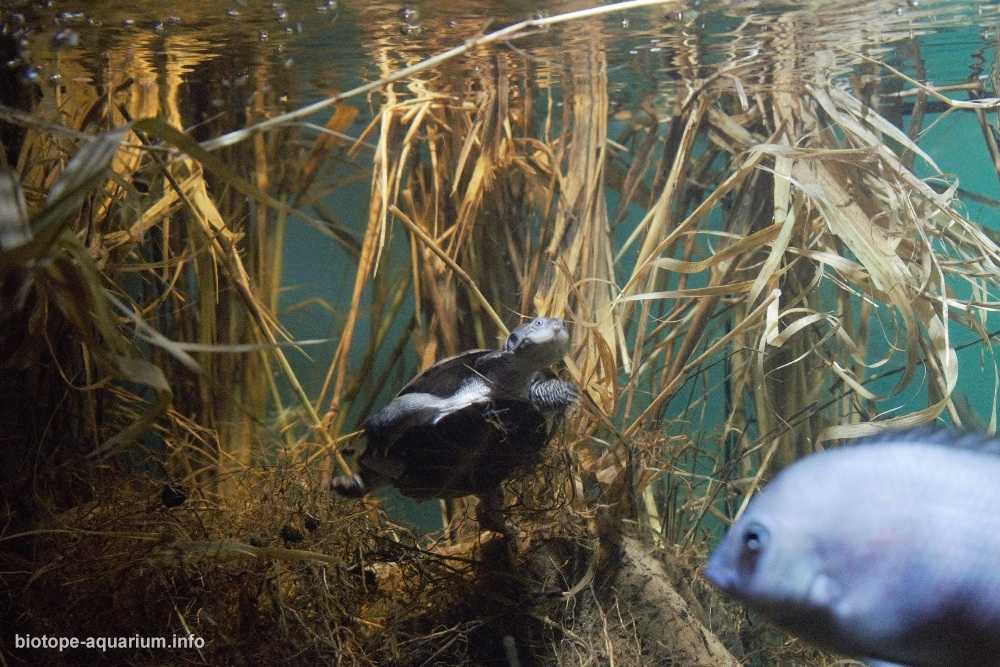
Description of the area surrounding the biotope: Lake Kinkony is located on the geographical coordinates 16 ° 9’0 “S 45 ° 50’0” E and its area is about 100 km², at the end of the rainy season reaches 150 km² and is the second largest lake in Madagascar after Lake Alaotra. The lake has a maximum length of 15 km, a width of 10.5 km and is surrounded by small temporary and permanent lakes, its south-eastern parts are fed by many rivers and small streams, the main tributary is a side leak from the Mahavavy River. The maximum rainfall is 1550 mm and occurs in January and February and the dry season lasts, about 210 days, periodically changing the panorama of the entire region. The assumed fluctuations in the water level are 4m, in the dry season the maximum depth is 2.5m, depth measurements of the lake have shown values in the range from 2.15m to 8.21m where water is cleaner. The water temperature on the surface is on the order of 25.5 ° C with a variable oxygen level between 5.85 and 8.50 mg / l, depending on the place and season varies 24 ° C – 33 ° C, the conductivity is 300/420 μS / cm and the pH is 6.7 – 8.3. The vegetation of the lake includes extensive Reed Reeds dominated by (Phragmites mauritianus) and where there is a Papyrus (Cyperus) you can also encounter several aquatic plants such as: Nymphaea lotus, Nymphaea stellata, Salvinia natans, Potamogeton sp. And even Pistia stratiotes. The name of the genus Paretroplus comes from the Greek “para”, which means “on the side”; in taxonomy is widely used in generic names to express similarity or kinship. Hence the name of the genus literally means “next to Etroplusa” and means a close relationship of these two types. The name of the dambabe species translates into the local language as “damba that is large”. Damba is the general name of the cichlids Paretroplus sp. In Madagascar divided into clades. Like all cichlids, P. dambabe has pharyngeal teeth. The upper and lower throat dental plates are well developed with strong teeth, the body is covered with large, overlapping scales. The color of this fish is grayish, pink or bluish green, depending on the mood and mood. The body is generally darker dorsal, but sometimes uniform in color. On the sides there is a variable intense red pigmentation (larger dots), especially below the upper branch line of the lateral line. Some individuals have each side scale outlined in red, while in others red pigmentation is limited to the area below the upper branch of the lateral line. Like most cichlids from the P.dambabe family, it does not have any sexually dimorphic features, that’s why they are bred for 6 pieces until they mature and choose a couple. In the natural environment, fish reproduce seasonally, in the aquarium approach spawning after a water change at 28 ° C, territoriality, stimulated aggression and increased appetite can be observed, on the other hand lowering the temperature to 24 ° C, we slow down the metabolism and the fish become milder. A few words about the turtle in Poland, also called Pelomedusa African or helminth (Pelomedusa subrufa) from the Greek pēlós, mud + name of the jellyfish, belongs to the suborder of the Pleurodira Turtles from the Pelomedusidae family. As of today, the genus Pelomeduza represents only one species, but it is quite possible that ongoing research will contribute to the identification of both new subspecies and species. This turtle is found throughout Africa south of the Sahara, Madagascar and part of the Arabian Peninsula. Pelomeduza is a common species and inhabits all kinds of shallow, muddy sweet water with standing water, or calmly flowing, both periodic and permanent. These are backwaters, ponds, lakes, rice fields, coastal areas of rivers and streams. African pelomedusa grows up to 15-20cm mostly and females are smaller than males, turtle has a light brown shield with black spots in the upper part, yellowish cream in the lower part. In nature, these turtles feed mainly on animal feed; they are snails, insects and their larvae, crustaceans, fish, amphibians, but sometimes they also devour a small reptile or a mammal. There have been reported successful hunts of pelomeduz group for water birds. They also feed on carrion. Turtles were also removed to remove ectoparasites from the skin of rhinoceroses visiting the water. During drought these turtles are buried in the muddy bottom. Pelomeduses go ashore to lay eggs, migrate between tanks in the rainy season (which may explain their wide range) and sunbathing. They prefer to choose logs lying in the water for heating. It is not necessary to warm up turtles living in shallow, and therefore quickly heating tanks. These turtles, while emptying, often bury the droppings in the ground, which must be remembered when cleaning the tank. Maintaining the right water quality, in addition to providing the optimal diet, is the most important problem in breeding these reptiles.
生物群落周边区域描述:金科尼湖位于南纬 16°9′0″、东经 45°50′0″,面积约为 100 平方公里,雨季结束时可达 150 平方公里,是马达加斯加仅次于阿劳特拉湖的第二大湖泊。该湖最大长度为 15 公里,宽度为 10.5 公里,周围分布着众多小型季节性湖泊和永久性湖泊;其东南部由多条河流和小溪补给,主要支流源自马哈瓦维河的侧向渗漏。年最大降雨量为 1550 毫米,集中于 1 月和 2 月,旱季持续约 210 天,周期性改变整个地区的地貌景观。推测水位波动幅度为 4 米;旱季时最大水深为 2.5 米,湖水深度测量值介于 2.15 米至 8.21 米之间,其中水质较为清澈。表层水温约为 25.5°C,溶解氧含量在 5.85 至 8.50 毫克/升之间变化;随地点和季节不同,水温变动范围为 24°C 至 33°C。电导率为 300–420 微西门子/厘米,pH 值为 6.7–8.3。 该湖泊的植被包括大片以毛里求斯芦苇(Phragmites mauritianus)为主的芦苇丛,在有纸莎草(Cyperus)生长的区域,还可发现多种水生植物,例如:白睡莲(Nymphaea lotus)、星花睡莲(Nymphaea stellata)、槐叶萍(Salvinia natans)、眼子菜属(Potamogeton sp.),甚至水葫芦(Pistia stratiotes)。属名”Paretroplus”源自希腊语”para”,意为“在……旁边”;在分类学中,该前缀广泛用于属名以表示相似性或亲缘关系。因此,该属名的字面含义为“靠近 Etroplusa 属”,表明这两类鱼类之间存在密切的亲缘关系。物种名”dambabe”在当地语言中意为“大型的大坝鱼”。”Damba”是马达加斯加对慈鲷科帕雷特罗普鲁斯属(Paretroplus sp.)鱼类的统称,该属在马达加斯加分为多个演化支。与其他慈鲷一样,P. dambabe 具有咽齿;其上下咽骨板发育良好,牙齿坚固,体表覆盖大型重叠鳞片。该鱼体色呈灰白色、粉红色或蓝绿色,具体取决于其情绪和状态。鱼体背部通常颜色较深,但有时全身颜色均匀。 体侧具有深浅不一的浓烈红色斑纹(较大斑点),尤以侧线上支下方为甚。部分个体的每一片鳞片均勾勒有红色边缘,而另一些个体的红色色素则仅限于侧线上支下方区域。与来自达马贝拟丽鱼群(P. dambabe group)的大多数慈鲷一样,该物种不具备任何性二型特征,因此通常需饲养 6 尾直至其成熟并自行配对。在自然环境中,鱼类呈季节性繁殖;在水族箱中,换水并将水温提升至 28°C 可诱导产卵,此时可观察到领地行为、攻击性增强及食欲上升;反之,将水温降至 24°C 则可减缓其新陈代谢,使鱼只性情更为温和。简要介绍在波兰被称为“非洲泥龟”或“蠕龟”的龟类(Pelomedusa subrufa):其属名源自希腊语”pēlós”(意为泥土)加上“水母”之名,隶属于侧颈龟亚目(Pleurodira)中的非洲侧颈龟科(Pelomedusidae)。截至目前,泥龟属(Pelomedusa)仅包含一个物种,但 ongoing 研究很可能有助于鉴定出新的亚种乃至新种。 这种龟分布于撒哈拉以南的非洲、马达加斯加以及阿拉伯半岛的部分地区。非洲侧颈龟(Pelomedusa)是一种常见物种,栖息于各类浅水、泥泞的淡水环境,包括静水或缓流的水体,无论其为季节性还是永久性水域。这些生境涵盖回水区、池塘、湖泊、稻田,以及河流与溪流的沿岸地带。非洲侧颈龟体长通常可达 15–20 厘米,雌性体型小于雄性;其背甲呈浅棕色并带有黑色斑点,腹甲则为淡黄奶油色。在自然环境中,这类龟主要以动物性食物为食,包括螺类、昆虫及其幼虫、甲壳类、鱼类和两栖类,有时也会捕食小型爬行动物或哺乳动物。曾有报道指出,成群的非洲侧颈龟成功猎杀水鸟。它们亦会摄食腐肉。此外,人们曾将此类龟引入特定区域,以清除造访水边的犀牛皮肤上的体外寄生虫。干旱期间,这些龟会埋入泥泞的底部。非洲侧颈龟会上岸产卵,并在雨季于不同水体间迁移(这或许可解释其分布范围之广),同时也会进行日光浴。它们偏好选择浸在水中的浮木作为晒背场所。 对于生活在浅水且因此升温迅速的水箱中的龟类,无需额外加热。这些龟在排泄时,常将粪便埋入底砂中,清洁水箱时需牢记这一点。除了提供最佳饮食外,维持适宜的水质是繁殖这些爬行动物最关键的问题。
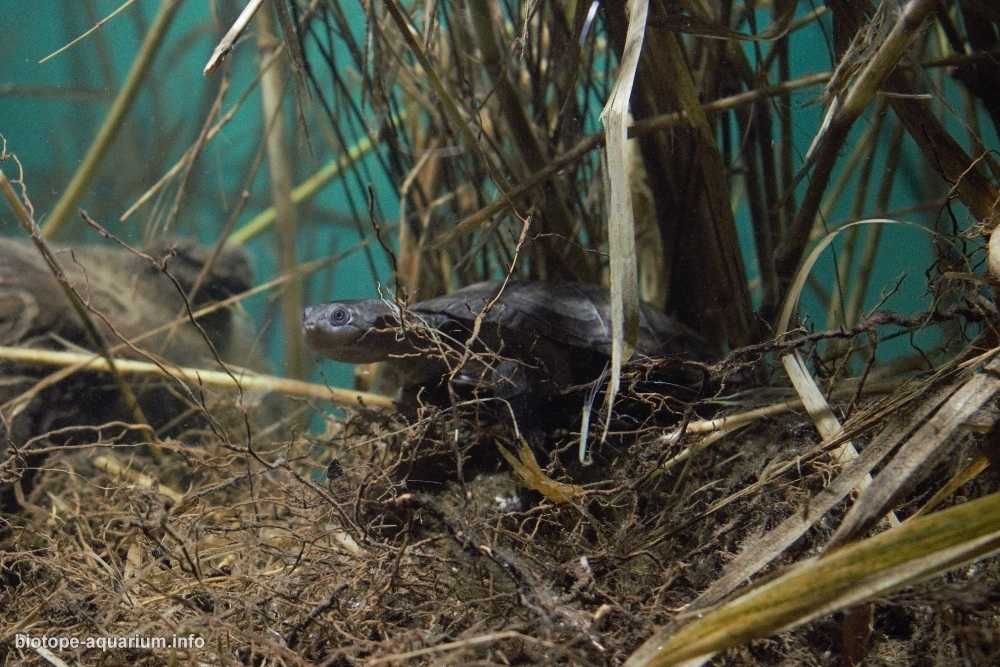
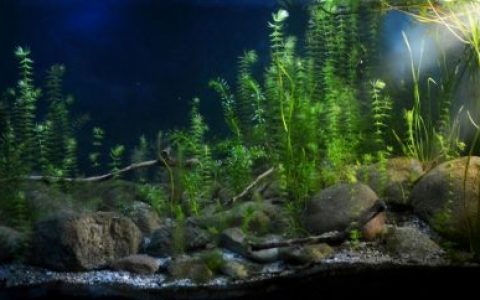
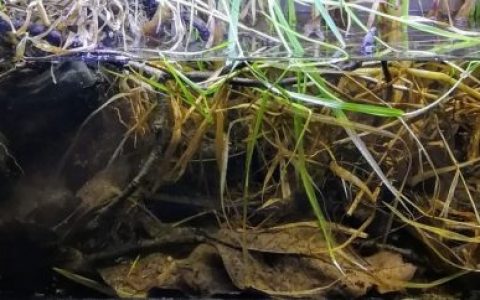
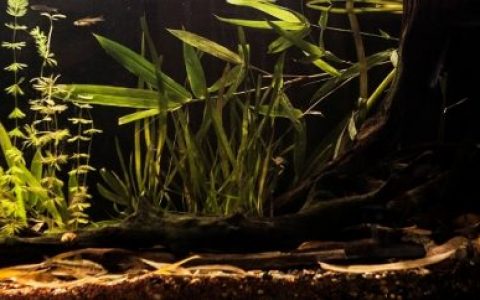
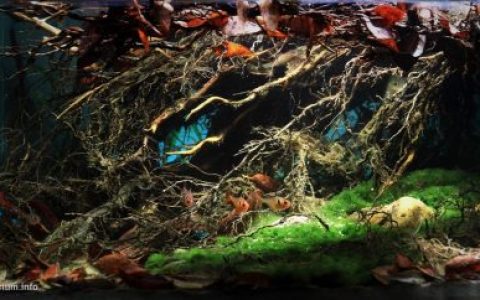
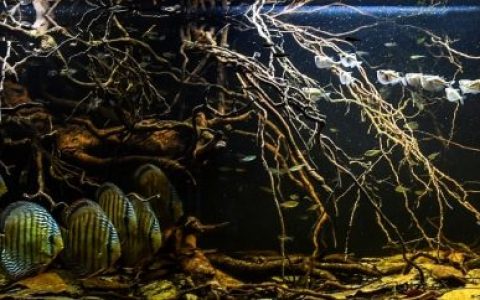
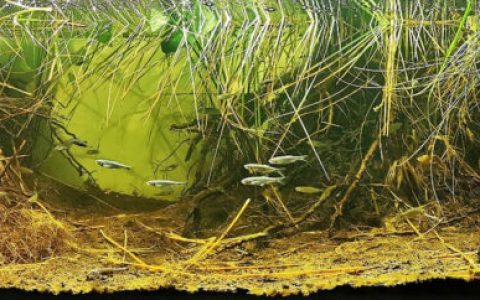
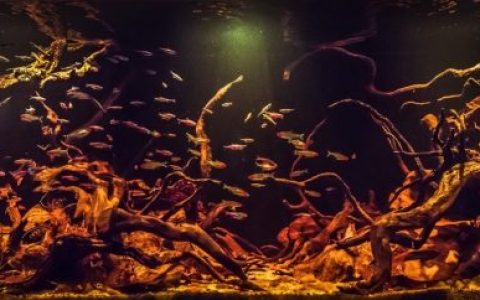
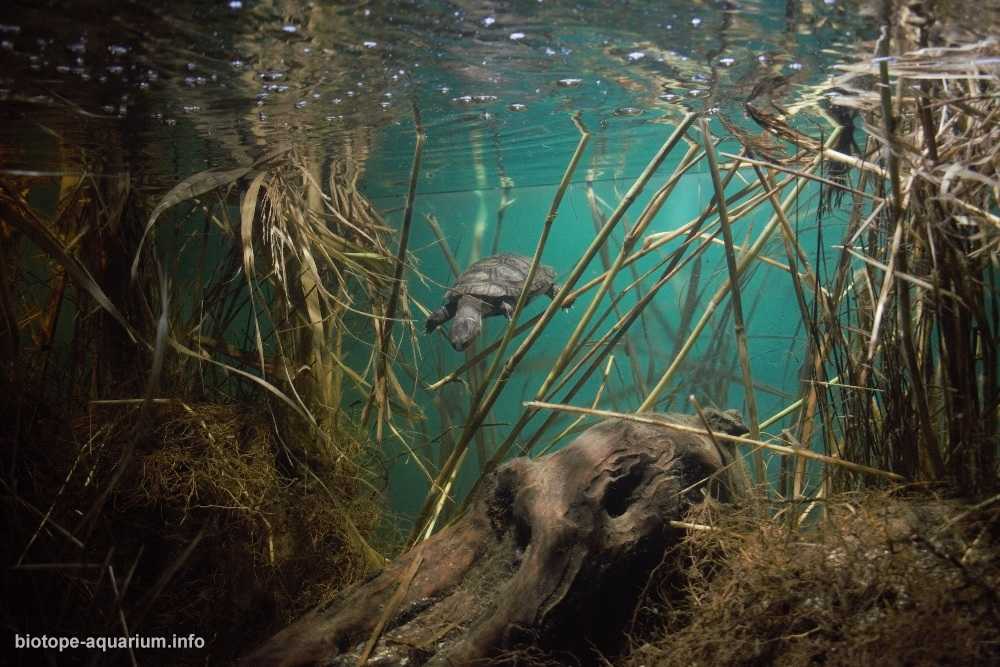
Description of the underwater landscape of the biotope: The aquarium presents a biotope of the flooded shore of the lake (reed beds) in the north-eastern part of the lake, at the beginning of the dry season. Hardscape is made of two artificial stones (imitating the edge) with dimensions of approximately 50×30, they are arranged on the sides and are separated by a 50×15 trunk creating a kind of ground clearance. Behind each stone, 10cm of reed space was left to omit the effect of the plane and muc to attach its bundles to smaller pebbles. These stones are properly prepared with roots, soil and sand, they perfectly simulate the shore of a flooded lake. Konar naturally divides the aquarium into a rebrand and in a short time its left side was occupied by a pair of P. dambabe, which chose a strategic place for spawning. Fish in just a few hours have dug a hole at the branch, leaving the shore behind, such habitats in nature are very important, because they provide young fish not only shelter, but also a secondary source of food rich in various forms of life.
生物群落水下景观描述:该水族箱呈现了马达加斯加西北部马哈赞加省金科尼湖东北部在旱季初期的淹没湖岸(芦苇床)生物群落。硬景由两块尺寸约为 50×30 厘米的人造石(模拟湖岸边缘)构成,它们分别布置于两侧,中间以一段 50×15 厘米的沉木隔开,形成类似离地间隙的结构。每块石头后方预留了 10 厘米的芦苇空间,以消除平面感,并将芦苇束固定在较小的鹅卵石上。这些石头经过精心布置,搭配树根、底土和沙子,完美模拟了被淹没湖泊的湖岸景象。沉木自然地将水族箱分隔开来,不久后其左侧便被一对大伴丽鱼(P. dambabe)占据,它们选择此处作为产卵的战略要地。鱼类仅在数小时内便在沉木旁挖掘出一个洞穴,将湖岸留在身后;此类栖息地在自然界中至关重要,因为它们不仅为幼鱼提供庇护所,还成为富含各种生命形式的次要食物来源。
Description of the parameters of the habitat: The water temperature on the surface is on the order of 25.5 ° C with a variable oxygen level between 5.85 and 8.50 mg / l, depending on the place and season varies 24 ° C – 33 ° C, the conductivity is 300/420 μS / cm and the pH is 6.7 – 8.3
栖息地参数描述:表层水温约为 25.5 °C,溶解氧含量在 5.85 至 8.50 mg/l 之间波动;具体数值因地点和季节而异,温度范围为 24 °C – 33 °C,电导率为 300/420 μS/cm,pH 值为 6.7 – 8.3。
List of fishes and invertebrates occurring in the nature biotope: Paretroplus dambabe, Paretroplus kieneri, Erymnochelys madagascariensis, Pelomedusa subrufa. Invasive sp. Carassius auratus, Tilapia rendalli and Oreochromis macrochir.
自然生境中出现的鱼类和无脊椎动物名录:达马巴副丽鱼(Paretroplus dambabe)、基纳副丽鱼(Paretroplus kieneri)、马达加斯加大头侧颈龟(Erymnochelys madagascariensis)、红腹侧颈龟(Pelomedusa subrufa)。入侵物种包括金鱼(Carassius auratus)、伦达尔罗非鱼(Tilapia rendalli)和大口莫桑比克罗非鱼(Oreochromis macrochir)。
List of plants found in the nature biotope: Phragmites mauritianus, Papirus Cyperus, Nymphaea lotus, Nymphaea stellata, Salvinia natans, Potamogeton sp. Pistia stratiotes, Eichhornia crassipes.
自然生境中发现的植物名录:毛里求斯芦苇(Phragmites mauritianus)、纸莎草(Cyperus papyrus)、白睡莲(Nymphaea lotus)、星花睡莲(Nymphaea stellata)、漂浮槐叶萍(Salvinia natans)、眼子菜属(Potamogeton sp.)、大薸(Pistia stratiotes)、凤眼蓝(Eichhornia crassipes)。
Threats to the ecology: The entire Mahavavy-Kinkony wetland complex is an ecologically diverse and economically critical set of habitats. Wetlands are an important place for aquatic flora and fauna, and despite receiving national protection, including the Ramsar Convention and several other conservation programs, the ecological integrity of Lake Kinkony is still threatened by the conversion of adjacent, unprotected areas into rice fields. The historic topographic range, on which the reed habitat from 1949 was applied, was compared with the deployment in 2008, and its result indicated a surface loss of 80% in the last 59 years. The results of the study confirm that the main factor contributing to the loss of reed was the increased turbidity associated with the seasonal river erosion and siltation of the area. Further degradation of habitat degradation increases in the face of serious threats of already critically endangered species of birds, fish and reptiles, a total of 97 species were recorded, of which 26 are endemic from Madagascar, Amaurornis olivieri, Paretroplus dambabe, P. kieneri, Erymnochelys madagascariensis are just a few examples of endemics on the red list of IUCN and CARES endangered species Paretroplus dambabe has CR (critically endangered) status and is a quite large cichlid, in nature reaches 19 centimeters in length, although they were discovered in the 1960s, they were confused with P. petiti for a long time and after DNA testing in 2002 by John Sparks from the American Museum of Natural History have been described as a new genre of P.dambabe. Radiological examination of the intestines of these fish revealed that the basic diet is small crustaceans, and this explains the attachment of this species to the edges of reed-rich reeds rich in various forms of life. The dambabe population has fallen drastically due to loss of habitat and overfishing, it is not about selling fish for commercial purposes. It should be remembered that Madagascar is one of the poorest countries in the world, the average monthly earnings are $ 50, the local population, in order to be able to feed their own family is doomed to poaching or growing rice. It is worth noting that due to the ban on the sale of these fish we will not buy at the local market, and their catches are food. The second important element which affects the gradual disappearance of P. dambabe from native biotopes, is associated with the introduction of alien invasive species, which compare to paretroplus sp. Do not need two years to pair up, grow faster and reach only one year, sexual maturity occupying the habitat. Previous studies have shown that tilap cichlids can live in water at temperatures above 35 ° C. A member of this invasive fish is able to survive in salinity 35 ‰, and the maximum lethal salinity for P.dambabe is 10 ‰. Tilapia in nature wreaks havoc, it is a very large cichlid, aggressive, durable and very fertile, bred in the ponds for commercial purposes and its meat is eagerly eaten, often sold in markets and markets along with fries or rice in many African countries.
生态面临的威胁:整个马哈瓦维 – 金科尼湿地复合体是一个生态多样且经济上至关重要的栖息地群。湿地是水生动植物的重要家园,尽管已获得包括《拉姆萨尔公约》及多项其他保护计划在内的国家层面保护,金科尼湖的生态完整性仍受到周边未受保护区域被开垦为稻田的威胁。将 1949 年芦苇栖息地所依据的历史地形范围与 2008 年的分布情况进行对比,结果显示在过去 59 年间其面积减少了 80%。研究结果证实,导致芦苇丧失的主要因素是与季节性河流侵蚀及该区域淤积相关的水体浊度增加。栖息地的进一步退化加剧了本已极度濒危的鸟类、鱼类和爬行动物所面临的严峻威胁;记录到的物种总数达 97 种,其中 26 种为马达加斯加特有物种,包括奥利维尔黑水鸡(Amaurornis olivieri)、达姆巴贝帕雷特罗普利斯鱼(Paretroplus dambabe)、P. 基内丽鱼(kieneri)、马达加斯加大头侧颈龟(Erymnochelys madagascariensis)只是国际自然保护联盟(IUCN)红色名录和 CARES 濒危物种名单中部分特有物种的例子。达姆巴贝帕雷特罗丽鱼(Paretroplus dambabe)被列为极危(CR)物种,是一种体型较大的慈鲷,在自然环境中体长可达 19 厘米。尽管该物种于 20 世纪 60 年代被发现,但长期以来被误认为小帕雷特罗丽鱼(P. petiti);直到 2002 年,美国自然历史博物馆的约翰·斯帕克斯(John Sparks)通过 DNA 检测,才将其描述为达姆巴贝帕雷特罗丽鱼(P. dambabe)这一新属。对这些鱼类肠道的放射学检查显示,其基本食物为小型甲壳类动物,这也解释了该物种为何栖息于芦苇丛生、生物多样性丰富的水域边缘。由于栖息地丧失和过度捕捞,达姆巴贝帕雷特罗丽鱼的种群数量急剧下降;这并非出于商业售鱼目的。需要铭记的是,马达加斯加是世界上最贫困的国家之一,人均月收入仅为 50 美元,当地居民为了养活家人,不得不从事偷猎或种植水稻。 值得注意的是,由于禁止销售这些鱼类,我们不会在当地市场购买它们,其捕捞量仅用于食用。导致帕雷特罗普勒斯·丹巴贝(P. dambabe)从其原生栖息地逐渐消失的第二个重要因素,与外来入侵物种的引入有关;与帕雷特罗普勒斯属(Paretroplus sp.)相比,这些入侵物种无需两年即可配对,生长更快,仅需一年便达到性成熟并占据栖息地。先前的研究表明,罗非鱼慈鲷可在高于 35°C 的水温中生存。此类入侵鱼类的一员能够在盐度为 35‰的环境中存活,而帕雷特罗普勒斯·丹巴贝的最大致死盐度仅为 10‰。罗非鱼在自然界中造成严重破坏:它是一种体型巨大、具有攻击性、耐受性强且繁殖力极高的慈鲷,常被出于商业目的在池塘中养殖,其肉质广受欢迎,在许多非洲国家的市场和集市上常与炸薯条或米饭一同出售。
本文部分素材来自网络,如有类似请联系修改,如若转载,请注明出处:http://www.yangyubang.com/?p=3320