Volume: 450 L 水体容积:450 升
Dimensions: 150x50x60 cm 尺寸:150×50×60 厘米
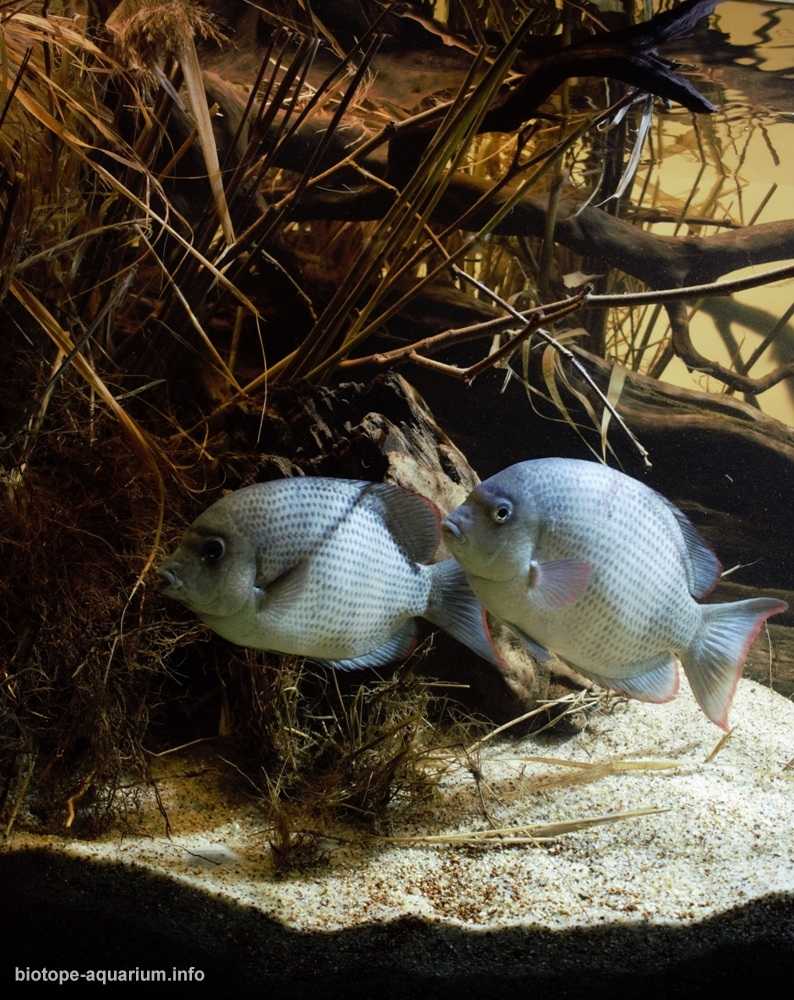
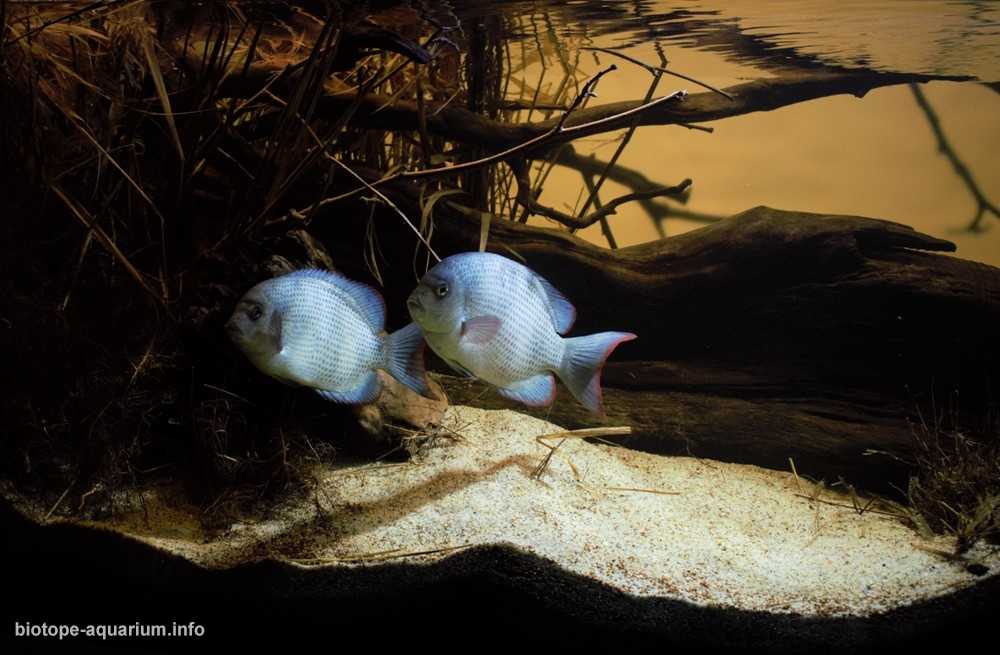
List of fishes: Mature couple Paretroplus menarambo.
鱼类名录:一对成年帕雷特罗普卢斯·梅纳拉姆博鱼(Paretroplus menarambo)。
List of plants: Dry reed Phragmites sp.
植物清单:旱芦苇(Phragmites sp.)
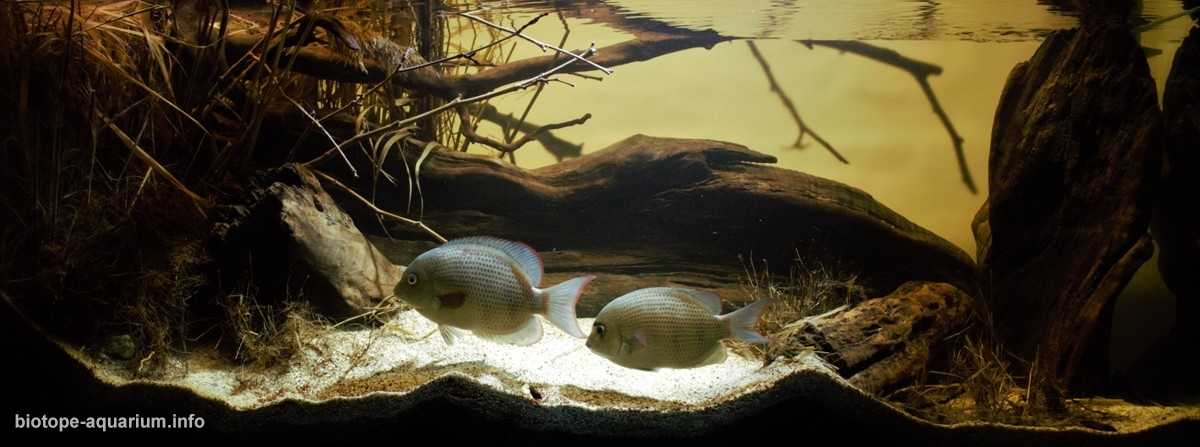
Description of decorations: Substrate: Mix sand light 0.4-1.2mm. The color observed in the photographs.
装饰描述:底砂:混合浅色细沙,粒径 0.4–1.2 毫米。颜色以照片中所见为准。
Description of equipment: Filtration: JBL CristalProfi e1901 greenline — 1900l / h bucket capacity of 15l divided into 5 baskets with media, one is a protective sponge, the other four is a biology divided between, Jbl Micromec balls and good quality sintered glass (ceramics).
设备描述:过滤系统:JBL CristalProfi e1901 greenline 外置滤桶,流量 1900 升/小时,容量 15 升,内部分为 5 个滤篮并填充滤材;其中一个为保护用海绵,其余四个用于生物过滤,分别装有 JBL Micromec 生物球及优质烧结玻璃(陶瓷)滤材。
Circulation: Two aeration cubes, JBL ProSilent a400
水流循环:两个增氧立方体,搭配 JBL ProSilent a400 气泵。
Heating: Eheim Jager 500W heating element, connected with the STC-1000 precision thermostat
加热系统:Eheim Jager 500W 加热棒,连接 STC-1000 精密温控器。
Light: The basic lighting is Aquatlantis Easy LED Freshwater, 1047mm, 6800 ° K-52w with EASY LED CONTROL, simulator of sunrise and sunset effect. Additionally, the lamp 6000 ° K-16w, led lamp 4000 ° K-10w, the old neon light T5 36w in a yellow shade, I suppose about 4000K was used to illuminate the background.
光照:基础照明采用带 EASY LED 控制器的 Aquatlantis Easy LED 淡水灯(1047 毫米,6800 K,52 瓦),可模拟日出和日落效果。此外,还使用了一盏 6000 K、16 瓦的灯,一盏 4000 K、10 瓦的 LED 灯,以及一盏旧式的黄色调 T5 36 瓦霓虹灯(推测色温约为 4000K)来照亮背景。
Water parameters: Ph 7.5 Gh14 Kh7 Temperature 28°C
水质参数:pH 7.5,GH 14,KH 7,温度 28°C。
Additional info: Due to the high organic content, water changes are 50% every 10 days, frequent refills, feeding takes place 4 times a day using JBL AutoFood, Fish often get sweets in the form of mussels, shrimps, etc.
补充信息:由于有机质含量较高,每 10 天换水 50%,并频繁补水。喂食每日进行 4 次,使用 JBL AutoFood 自动喂食器;鱼类常获得贻贝、虾等形式的“甜食”。
INFORMATION ABOUT BIOTOPE
关于生物群落的信息
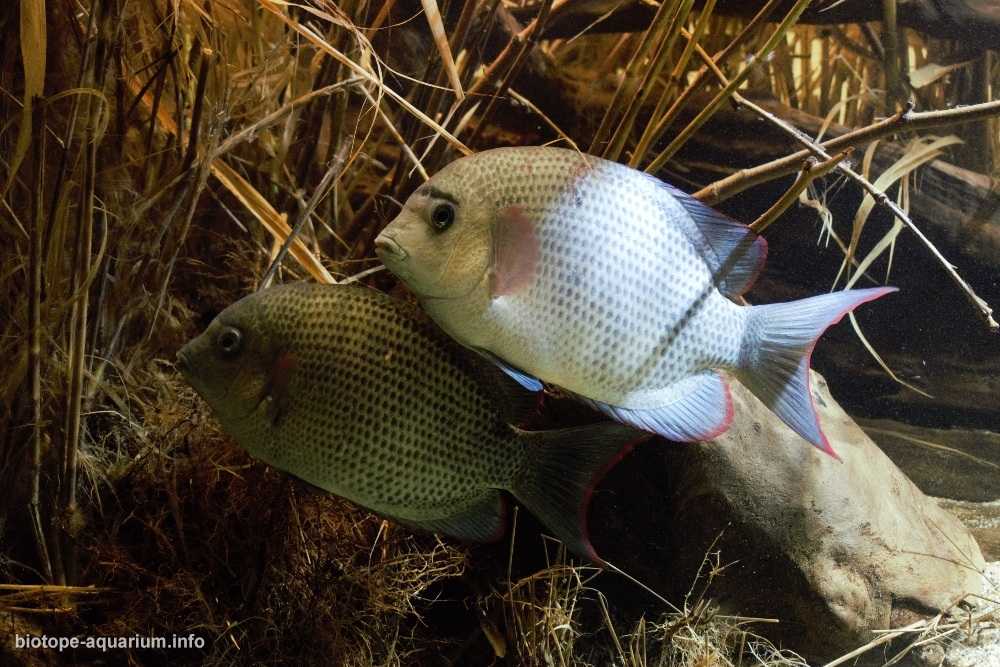
Description of the area surrounding the biotope: Madagascar is a state island located in the Indian Ocean, off the east coast of Africa, opposite Mozambique, and is the fourth largest island in the world. There are no species of animals and plants typical of continental Africa on the island and their endemic reaches as much as 80%, together 5% of the flora and fauna of the whole world. Madagascar is a fragment of the ancient supercontinent of Gondwana, Doctor Harry Levin explains the Mesozoic geographical ties of India with Madagascar and Madagascar with Africa. Explaining that cichlids have evolved from marine fish, brackish fish (estuary) to freshwater fish, more or less after the beginning of the Permian era to the end of the Triassic, adapting to land movements and climate change. Once the pathways have been determined by the radiation of species, some of these fish still designate ancient geography. The cichlidae family tells us the amazing history of the land, Madagascar, about 245 million years ago, was part of India. In particular, the north-eastern coast of Madagascar was connected to the coast of Kerala, furthermore, in the middle of Madagascar it was connected to Africa by a land bridge, which was on common widths, Maevatanana in Madagascar and Lake Malawi in Africa. When Gondwana began to crumble (about 160 million years ago) Madagascar, it separated from Africa first and then from India (89 million years ago). This isolation made Madagascar what some biogeographers call “the eighth continent”. Cichlids belonged to the earliest freshwater fish and developed along the south-eastern coast of India, first as salty fish, stretching along the east coast of Madagascar, which was in the process of separation from India. In northwestern Madagascar, the species of cichlids have evolved into freshwater fish and crossed the land bridge to Africa. After rapid diversification, freshwater cichlids radiated throughout Africa; and they came to South America. The unique diversity of the family (freshwater fish) Cichlidae (order Perciformes) raised it to icons in textbooks of evolutionary biology (cichlids) have a wide range of colors, forms and habits. They come from warm rivers and lakes in Africa, Madagascar, southern India, Sri Lanka and South and Central America, most of these regions were part of the southern continent of Gondwana, the observation suggests an ancient pedigree for the whole family. Today, Paretroplus from Madagascar and Etroplus from India, and in particular P. polyactis, E. suratensis and E. maculates, are unique among cichlids and are considered primitive, 15 species are found in Madagascar and 3 in southern India. These eighteen species of “survivors from the earliest lines” indicate coherence between Madagascar and southern India in the distant past. Can these present-day cichlids from Madagascar and India be sufficiently closely related to justify the conclusion that their ancestors are from the same fish? Now, Madagascar and India are about 4,500 km apart. Many of these ancient species have survived in Madagascar, which their competitors growing in Africa could not reach; also India has been isolated for millions of years, by far the largest diversity of cichlids is found in Africa, in particular in the large East African lakes of Victoria, Malawi and Tanganyika. In addition to the above ancient geography lessons offered by these fish, the proving proofs of late-Palaeozoic conformations of India, Sri Lanka and Madagascar, offer two plants of primitive, insectivorous pitchers: namely Nepenthusian Nepenthus distillery and Nepenthes nepal, both order Caryophyllales, Nepenthaceae family, distillatoria is the only endemic plant in Sri Lanka. N. masoalensis is one of the two endemic plants of Madagascar. The characteristic rivers, lakes and swamps of Madagascar still hide some of these ancient fish species, one of such places is Lake Tseny, where we can find the hero of this biotope Paretroplus Menarambo. The geographical coordinates of the lake are 15 ° 40 ‘0.01 “S, 47 ° 50’ 59.59” E a reconstructed habitat: 15 ° 40’47.9 “S 47 ° 49’32.4” E near the village of Miadana in the south-west of Lake Tseny, depth in this place is 2.5 m-5 m, PH: 7.3, temperature 24 ° C-29.5 ° C. The lake is particularly beautiful, covered with light sand, located in the landscape of grassy hills, the coastline consists of numerous coves intersected by small islands overgrown with reeds with a height of three meters and sporadic palm trees. The lake is located in the wetland complex in the lower lagoon of the Sofia river, it is a seasonal transformation landscape because it undergoes serious water level fluctuations according to the rainy season (January-April) and dry (May-December) fishermen inform that the depth of the lake varies from three meters to twelve. Along the western shore of the lake is a sunken forest, which is a key feature of the lake, and its presence creates many spawning habitats for these endemic cichlids. Braided roots and branches provide free space from predators and competitors, and algae and bacteria that can feed large populations of invertebrates, diversifying the diet of young and adult P. menarambo. In some places only branches and branches emerge from the water, while the remains of trunks and trees are submerged. These trees prevent fishermen from spreading gillnets and these areas are subject to minimal fishing pressure, yet fishermen sometimes extend their nets in open water parallel to the sunken forest and hitting the water surface with rods, scare the fish. Such a fish fishing system is often used by most fishermen, a stick called debocas is a simple one and a half stick, at the end of which is a leather cone, which after hitting the surface of the water produces a specific noise (strong clap). Here it should be emphasized that P. menarambo are very sensitive to sound, which is associated with the spawning period and the problem of keeping the fry in aquarium conditions. During spawning the fish startle and eat roe, it’s hard to keep eggs with parents, as of today only two people have succeeded, other hobbyists take eggs and feed their parents to sterile tanks. In the natural environment, only a pair of P. menarambo was observed once in the company of two hundred young people. Fishermen say that the species reproduces in October and November and that it is the most numerous between October and December. Endemic cichlids reproduce in a sunken forest, while other species can reproduce anywhere within the lake. The name of the menarambo species refers to the combination of two words of the Malagasy word “mena”, which means red and “rambo”, which means the tail. Paretroplus menarambo is a relatively large fish, reaches 25 centimeters, and its body is high and flat, the tail has a crescent shape with a red border, which gives it the charm of sea fish. The body is covered with large, overlapping scales. The bases of the dorsal and anal fin have well-developed rays. The color oscillates from light gray to greyish-green, giving the fish a pinstripe “stripe damba” look. Like all cichlids, P. menarambo has pharyngeal teeth. The upper and lower throat tooth plates are well developed with strong teeth, two longer fangs give them a vampire look. There are no sexual dimorphic features, but there are minimal differences in the structure of fins, in males are slightly longer and pointed than in females. Like most cichlids from Madagascar, P. menarambo are slow-growing fish and it will take almost 2 years to reach maturity. In the aquarium it is recommended to breed in a group of six, so that after reaching maturity the fish become pairs. In Lake Tseny, you can find seven native species, including the first three endemics, Paretroplus menarambo, Paretroplus lamenabe, Paretroplus cf. kieneri, turtle (Erymnochelys madagascariensis), Arius festinus, Cyprinoides galops, Sauvagella robusta and Glossogobius giuris. Also the presence of invasive species: Heterotis niloticus, Channa maculata, Cyprinus carpio and three species tilapiine Oreochromis n. Niloticus, O. mossambicus and Tilapia zillii.
生物群落周边区域描述:马达加斯加是位于印度洋的一座岛国,地处非洲东海岸外,与莫桑比克隔海相望,为世界第四大岛。岛上没有典型的大陆非洲动植物物种,其特有物种比例高达 80%,合计占全球动植物区系的 5%。马达加斯加是远古超大陆冈瓦纳的残存部分。哈里·莱文博士阐释了中生代时期印度与马达加斯加、以及马达加斯加与非洲之间的地理联系。他指出,慈鲷科鱼类从海洋鱼类、半咸水鱼类(河口)演化为淡水鱼类,这一过程大致发生在二叠纪初期至三叠纪末期,以适应陆地运动和气候变化。一旦物种辐射确定了演化路径,其中一些鱼类仍能反映古老的地理格局。慈鲷科家族向我们揭示了这片土地令人惊叹的历史:约 2.45 亿年前,马达加斯加曾是印度的一部分。 特别是,马达加斯加的东北海岸曾与喀拉拉邦海岸相连;此外,在马达加斯加中部,它通过一片陆地桥与非洲相连,该陆桥的宽度大致相当于马达加斯加的马埃瓦塔纳纳与非洲的马拉维湖之间的距离。当冈瓦纳古陆开始分裂(约 1.6 亿年前)时,马达加斯加首先与非洲分离,随后又与印度分离(8900 万年前)。这种隔离使马达加斯加成为一些生物地理学家所称的“第八大洲”。慈鲷属于最早的淡水鱼类之一,最初作为咸水鱼在印度东南沿海演化,随后沿着当时正与印度分离的马达加斯加东海岸分布。在马达加斯加西北部,慈鲷物种演化为淡水鱼,并经由陆桥迁徙至非洲。经过快速多样化,淡水慈鲷辐射扩散至整个非洲,并最终抵达南美洲。慈鲷科(隶属鲈形目)作为淡水鱼类所具有的独特多样性,使其成为进化生物学教科书中的标志性案例:慈鲷拥有极其丰富的色彩、形态和行为习性。 它们来自非洲、马达加斯加、印度南部、斯里兰卡以及南美洲和中美洲的温暖河流与湖泊,这些地区大多曾是冈瓦纳古陆南部的一部分,这一观察结果表明整个慈鲷科拥有古老的谱系。如今,产自马达加斯加的帕雷特罗丽鱼属(Paretroplus)和产自印度的埃特罗丽鱼属(Etroplus),尤其是多棘帕雷特罗丽鱼(P. polyactis)、苏拉特埃特罗丽鱼(E. suratensis)和斑纹埃特罗丽鱼(E. maculates),在慈鲷中独树一帜,被视为原始类群;其中马达加斯加分布有 15 种,印度南部有 3 种。这十八种“最早谱系的幸存者”表明,在遥远的过去,马达加斯加与印度南部之间存在生物地理上的联系。现今来自马达加斯加和印度的这些慈鲷,其亲缘关系是否足够密切,足以支持它们的祖先源自同一鱼类这一结论?如今,马达加斯加与印度相距约 4,500 公里。许多这类古老物种在马达加斯加得以幸存,因为它们在非洲的竞争对手无法抵达该地;同样,印度也已隔离数百万年之久。迄今为止,慈鲷多样性最高的地区是非洲,尤其是东非的大型湖泊——维多利亚湖、马拉维湖和坦噶尼喀湖。 除了这些鱼类所展现的古老地理课程之外,印度、斯里兰卡和马达加斯加晚古生代构造的证据还体现在两种原始的食虫猪笼草上:即属于石竹目、猪笼草科的蒸馏猪笼草(Nepenthes distillatoria)和尼泊尔猪笼草(Nepenthes nepal),其中蒸馏猪笼草是斯里兰卡特有的唯一植物。马苏阿拉猪笼草(N. masoalensis)则是马达加斯加两种特有植物之一。马达加斯加特有的河流、湖泊和沼泽仍然隐藏着一些古老的鱼类物种,其中之一便是特尼湖(Lake Tseny),这里栖息着本生物缸的主角——红带六间鱼(Paretroplus menarambo)。该湖的地理坐标为南纬 15°40′0.01″,东经 47°50′59.59″;而重建栖息地的坐标为南纬 15°40′47.9″,东经 47°49′32.4″,位于特尼湖西南部的米亚达纳村附近,此处水深为 2.5 至 5 米,pH 值为 7.3,水温介于 24°C 至 29.5°C 之间。该湖景色尤为优美,湖底覆盖着浅色沙子,坐落于绿草如茵的丘陵景观之中,湖岸线由众多小海湾组成,其间点缀着被三米高芦苇和零星棕榈树覆盖的小岛。 该湖位于索菲亚河下游泻湖的湿地综合体中,由于雨季(1 月至 4 月)和旱季(5 月至 12 月)导致水位剧烈波动,其景观呈现季节性变化;据渔民介绍,湖水深度在 3 米至 12 米之间变动。沿湖西岸分布着一片沉没森林,这是该湖的关键特征,其存在为这些特有慈鲷创造了众多产卵栖息地。交织的根系与枝干为鱼类提供了躲避捕食者和竞争者的自由空间,而其上附着的藻类和细菌能够供养大量无脊椎动物,从而丰富了幼年和成年帕氏门拉姆博慈鲷(P. menarambo)的食物来源。在某些区域,仅有枝条露出水面,而树干和树木的残骸则淹没于水下。这些树木阻碍了渔民布设刺网,使得这些区域受到的捕捞压力极小;然而,渔民有时仍会在开阔水域将渔网平行于沉没森林延伸,并用杆棒击打水面以惊驱鱼群。 这种捕鱼系统常被大多数渔民使用:一种名为”debocas”的简易工具由一根半长的木棍构成,末端系有一个皮革锥体;当其击打水面时,会发出特定的声响(响亮的拍击声)。此处需特别强调,红尾慈鲷(P. menarambo)对声音极为敏感,这与其繁殖期以及在人工水族箱条件下饲养鱼苗的难题密切相关。繁殖期间,亲鱼易受惊扰而吞食鱼卵,因此很难让鱼卵与亲鱼共存;截至目前,仅有两人成功实现这一目标,其他爱好者则会将鱼卵取出,并将亲鱼转移至隔离水箱中。在自然环境中,仅曾观察到一对红尾慈鲷与约两百尾幼鱼共同活动。渔民表示,该物种于十月和十一月繁殖,且在十月至十二月期间数量最为庞大。当地特有的慈鲷科鱼类会在淹没的森林中繁殖,而其他物种则可在湖内任何区域产卵。”menarambo”这一物种名称源自马达加斯加语中两个词的组合:”mena”意为红色,”rambo”意为尾巴。 帕雷特罗普勒斯·梅纳拉姆博(Paretroplus menarambo)是一种体型较大的鱼类,体长可达 25 厘米,身体高而侧扁,尾鳍呈新月形并带有红色边缘,赋予其海水鱼般的魅力。体表覆盖着大型且相互重叠的鳞片。背鳍和臀鳍的基部具有发达的鳍条。体色在浅灰色至灰绿色之间变化,使鱼呈现出细条纹的”stripe damba”外观。与其他慈鲷一样,帕雷特罗普勒斯·梅纳拉姆博拥有咽齿;其上、下咽骨板发育良好,牙齿强壮,其中两颗较长的犬齿使其呈现出吸血鬼般的外观。该物种无明显的两性异形特征,但鳍的结构存在细微差异:雄鱼的鳍略长且更尖,而雌鱼则较短圆。与大多数来自马达加斯加的慈鲷相似,帕雷特罗普勒斯·梅纳拉姆博生长缓慢,需将近两年时间才能达到性成熟。在水族箱中,建议以六尾为一组进行饲养,以便它们在性成熟后自然配对。在切尼湖(Lake Tseny)中,可发现七种原生鱼类,其中包括前三种特有物种:帕雷特罗普勒斯·梅纳拉姆博(Paretroplus menarambo)、帕雷特罗普勒斯·拉梅纳贝(Paretroplus lamenabe)以及帕雷特罗普勒斯未定种(Paretroplus cf.)。 基内丽鱼、马达加斯加大头龟(Erymnochelys madagascariensis)、快速海鲇(Arius festinus)、疾行鲤形鱼(Cyprinoides galops)、健壮索瓦热鱼(Sauvagella robusta)以及吉氏舌虾虎鱼(Glossogobius giuris)。此外还存在入侵物种:尼罗异耳骨舌鱼(Heterotis niloticus)、斑鳢(Channa maculata)、鲤鱼(Cyprinus carpio)以及三种罗非鱼类——尼罗罗非鱼(Oreochromis n. niloticus)、莫桑比克罗非鱼(O. mossambicus)和齐利罗非鱼(Tilapia zillii)。
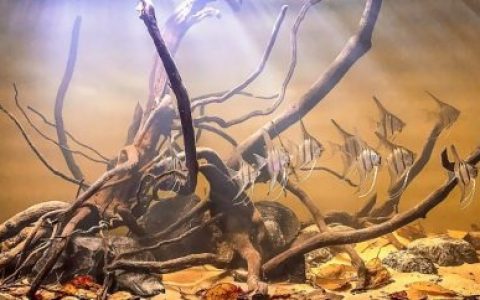
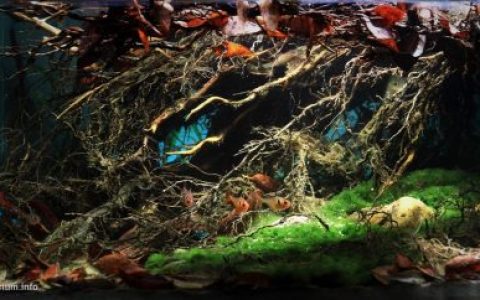
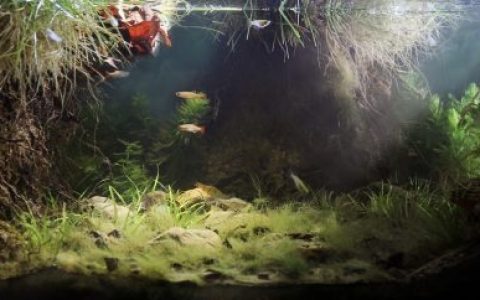
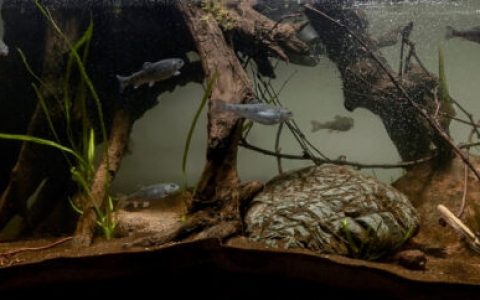
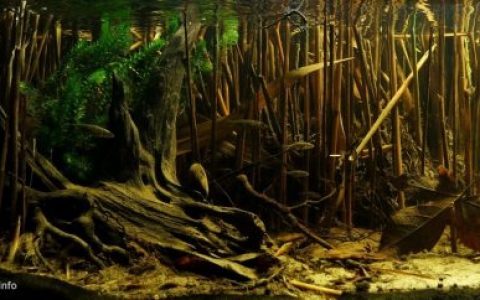
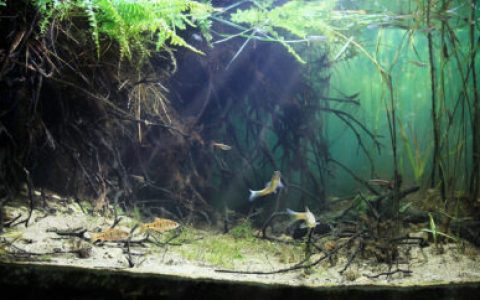
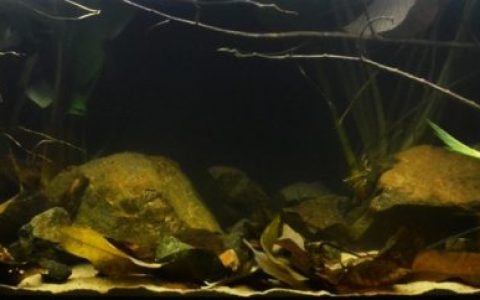
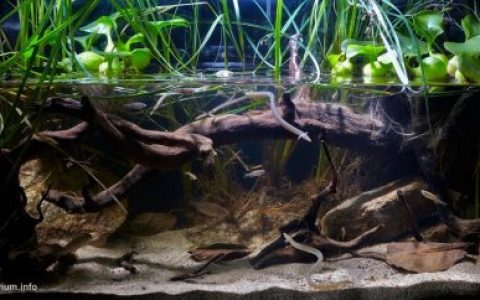
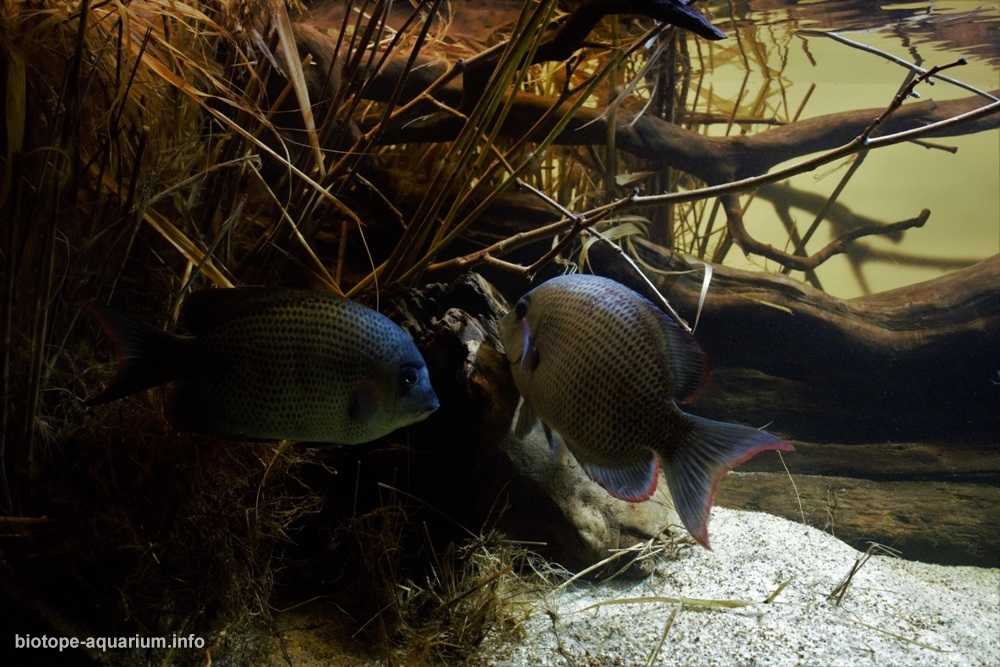
Description of the underwater landscape of the biotope: The aquarium presents the biotope of the coastal zone between the reeds and the sandy bottom of the lake, where the sunken forest is located. Boughs and branches of dead trees provide fish with shelter and suitable spawning grounds. The edges of the habitats are often overgrown reeds, where there are plenty of crustaceans, which are a great source of food for the young fry P. menarambo. The vertical branch on the right imitates a tree protruding above the water (as in the photograph in the link), which creates a natural barrier of the sunken forest. A matte self-adhesive foil backlit with warm light from an old neon lamp was glued to the rear window. A long branch over the big branch is arranged an interesting technique. Half of the branch is in the aquarium (wet) and the other half, behind the background (dry) combined into a whole gives us a greater underwater depth.
生物群落水下景观描述:该水族箱呈现了湖泊沿岸区域的生物群落,介于芦苇丛与湖底沙地之间,此处分布着沉没的森林。枯树的枝干为鱼类提供了庇护所和适宜的产卵场。栖息地边缘常生长着茂密的芦苇,其中富含大量甲壳类动物,成为幼鱼 P. menarambo 的优质食物来源。右侧垂直放置的枝条模拟了伸出水面的树木(如链接中的照片所示),从而形成沉没森林的天然屏障。后窗贴覆了一张哑光自粘背胶膜,并由一盏旧式霓虹灯提供温暖的背光照明。在大枝条上方布置了一根长枝条,采用了一种巧妙的技法:枝条一半位于水族箱内(湿润部分),另一半延伸至背景后方(干燥部分),两者结合成整体,营造出更深邃的水下空间感。
Description of the parameters of the habitat: PH: 7.3, temperature 24°C-29,5°C
栖息地参数描述:pH 值 7.3,温度 24°C–29.5°C
List of fishes and invertebrates occurring in the nature biotope: Endemic: Paretroplus menarambo, Paretroplus lamenabe, Paretroplus cf. kieneri, turtle (Erymnochelys madagascariensis), Arius festinus, Cyprinoides galops, Sauvagella robusta and Glossogobius giuris.
该自然生境中分布的鱼类和无脊椎动物名录:特有种包括帕雷托普勒斯鱼(Paretroplus menarambo)、帕雷托普勒斯拉梅纳贝鱼(Paretroplus lamenabe)、近似基纳氏帕雷托普勒斯鱼(Paretroplus cf. kieneri)、马达加斯加大头龟(Erymnochelys madagascariensis)、费斯提努斯海鲇(Arius festinus)、加洛普斯鲤形鱼(Cyprinoides galops)、 robusta 索瓦热拉鱼(Sauvagella robusta)以及吉氏舌虾虎鱼(Glossogobius giuris)。
Invasive: Heterotis niloticus, Channa maculata, Cyprinus carpio and three species tilapiine Oreochromis n. Niloticus, O. mossambicus and Tilapia zillii.
入侵物种包括尼罗异耳鱼(Heterotis niloticus)、斑鳢(Channa maculata)、鲤鱼(Cyprinus carpio)以及三种罗非鱼:尼罗罗非鱼(Oreochromis n. niloticus)、莫桑比克罗非鱼(O. mossambicus)和齐利罗非鱼(Tilapia zillii)。
List of plants found in the nature biotope: Phragmites mauritianus, Cyperus papyrus.
该自然生境中发现的植物名录:毛里求斯芦苇(Phragmites mauritianus)和纸莎草(Cyperus papyrus)。
Threats to the ecology: Madagascar lost 80% of the original forest cover, and many of its most charismatic species experienced a sharp decline in population because the availability of primary forest habitats has decreased. Experts, for example, estimate that 95% of 105 species of lemur in Madagascar are currently threatened with extinction and Madagascar was the main driver of habitat loss in Madagascar — according to the FAO 2010, Madagascar continued to lose around 57,000 hectares of forest annually. Deforestation applies not only to forest species, but also has a significant impact on Madagascar freshwater ecosystems. An example of this is the fact that of the 12 bird species in Madagascar classified as endangered or critically endangered on the IUCN Red List, 9 are wetland species. Since 1960, the wetlands of the Madagascar mountain region have decreased by 60% and during the same period, the country also lost 37% of coastal forests. Fish in Madagascar are particularly vulnerable to extinction as a result of habitat loss, as many species are not only endemic to the island, but have small ranges, meaning that the loss of one site can drastically reduce the chance of survival of many species. A recent study by the IUCN unit on freshwater biodiversity regarding the state of protection of Madagascar freshwater fish showed that 34% of species were threatened with extinction. However, even more worryingly, assuming that the same level of risk applies to those species for which there was no data (species insufficient for data), this number increases to 43% for all fish and up to 78% for those endemic to Madagascar. Two species (Ptychochromis onilahy and Pantanodon madagascariensis) are already classified as extinct. The percentage of freshwater species assessed as threatened with extinction was about twice as high as documented on the entire African continent as a whole. Tseny is the only lake where we can meet P.menarambo. Hence the efforts to protect this lake. All conservation measures have been taken into account, given that over 90% of the population around the lake are fishermen. The use of biological resources, fishing and collection of water resources, invasive species and, consequently, diseases of foreign origin, from year to year, decreases the populations of P. menarambo in the lake. The IUCN red list shows the status of Paretroplus menarambo as (Critically Endangered). Breeding populations of this species are kept in captivity. The Zoological Society of London, the Toronto Zoo, the Paul VI Loiselle protection fund and several other programs, jointly sponsoring breeding in artificial ponds with Mr. Guy Tam Hyok from Andapa, Madagascar. In 2017, the population of Paretroplus menarambo in Lake Tseny was increased by moving fish from the Andapa plant. The other endangered species of Malgrass cichlids Ptychochromis insolitus, Paretroplus maculatus, P. nourissati and several others are also included in this wonderful program. Thanks to Claudia Dickinson, the image of P. menarambo was placed in the logo of C.A.R.E.E., and his figure became the symbol of all dying species. As of today, this species is grown by few hobbyists and enthusiasts, the fact is that the most endangered species from Madagascar in Europe are found by collectors from Poland.
生态面临的威胁:马达加斯加失去了 80% 的原始森林覆盖,许多最具魅力的物种因原生森林栖息地的减少而种群数量急剧下降。例如,专家估计,马达加斯加 105 种狐猴中有 95% 目前面临灭绝威胁;而根据联合国粮农组织(FAO)2010 年的数据,马达加斯加每年继续损失约 57,000 公顷森林,是该国栖息地丧失的主要驱动因素。森林砍伐不仅影响森林物种,也对马达加斯加的淡水生态系统产生重大影响。一个例证是:在《世界自然保护联盟濒危物种红色名录》中列为濒危或极危的 12 种马达加斯加鸟类中,有 9 种为湿地物种。自 1960 年以来,马达加斯加山区的湿地面积减少了 60%,同期该国还失去了 37% 的沿海森林。 马达加斯加的鱼类因栖息地丧失而面临极高的灭绝风险,因为许多物种不仅是该岛的特有种,而且分布范围狭窄,这意味着单一地点的丧失就可能大幅降低众多物种的生存几率。国际自然保护联盟(IUCN)淡水生物多样性部门近期开展的一项关于马达加斯加淡水鱼类保护状况的研究显示,34% 的物种濒临灭绝。然而更令人担忧的是,若假设数据不足的物种(即缺乏足够数据的物种)面临同等程度的风险,则所有鱼类的受威胁比例将升至 43%,而马达加斯加特有种的这一比例更高达 78%。目前已有两个物种(Ptychochromis onilahy 和 Pantanodon madagascariensis)被正式列为灭绝。评估为濒临灭绝的淡水物种比例约为整个非洲大陆 documented 比例的两倍。Tseny 湖是唯一能发现 P. menarambo 的湖泊,因此保护该湖的努力至关重要。鉴于湖区周边超过 90% 的居民以捕鱼为生,所有保护措施均已纳入考量。 生物资源的利用、捕捞和水资源采集,以及外来入侵物种及其引发的外来疾病,逐年导致湖中帕雷特罗普勒斯·梅纳拉姆博(P. menarambo)的种群数量下降。世界自然保护联盟(IUCN)红色名录将帕雷特罗普勒斯·梅纳拉姆博(Paretroplus menarambo)的濒危状态列为“极危”。该物种的繁殖种群已在人工饲养环境下得到保存。伦敦动物学会、多伦多动物园、保罗六世·洛伊塞尔保护基金以及其他多个项目,共同资助与马达加斯加安达帕的盖伊·谭·霍克(Guy Tam Hyok)先生在人工池塘中开展的繁殖工作。2017 年,通过从安达帕繁育基地转移鱼类,增加了岑尼湖(Lake Tseny)中帕雷特罗普勒斯·梅纳拉姆博的种群数量。其他濒危的马拉加西慈鲷物种,如隐栖普蒂克罗米斯(Ptychochromis insolitus)、斑纹帕雷特罗普勒斯(Paretroplus maculatus)、努里萨蒂帕雷特罗普勒斯(P. nourissati)等数个物种,也被纳入这一卓越的保护计划。得益于克劳迪娅·迪金森的努力,帕雷特罗普勒斯·梅纳拉姆博的形象被置于 C.A.R.E.E. 的标志之中,其形象已成为所有濒临灭绝物种的象征。截至目前,该物种仅由少数爱好者和发烧友饲养;事实上,在欧洲,来自马达加斯加的最濒危物种主要由波兰的收藏家发现。
本文部分素材来自网络,如有类似请联系修改,如若转载,请注明出处:http://www.yangyubang.com/?p=3353