Volume: 600 L 容量:600 升
Dimensions: 600 L corner aquarium, with one side longer 120x65h, 95x65h, front is 100x65h. The aquarium is turned so that the 120 cm long side is a panorama, that is, the front.
尺寸:600 升角形水族箱,一边长 120x65h,另一边 95x65h,正面为 100x65h。水族箱旋转,使 120 厘米长的边成为全景,即正面。
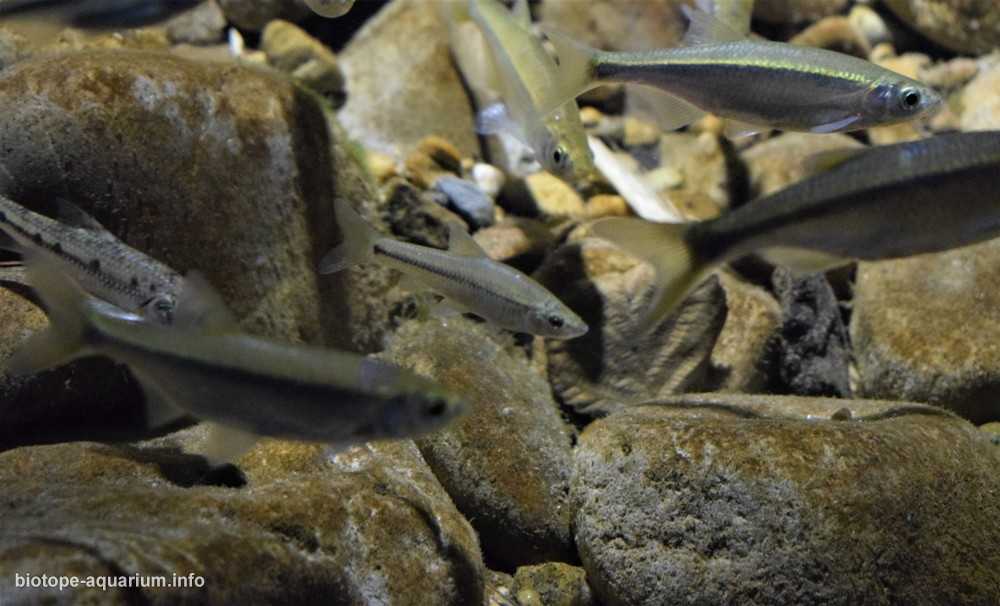
List of fishes: Alburnus arborella, Cobitis bilineata, Gobio gobio, Padogobius bonelli, Knipowitschia punctatissima, Pseudorasbora parva
鱼类列表:Alburnus arborella、Cobitis bilineata、Gobio gobio、Padogobius bonelli、Knipowitschia punctatissima、Pseudorasbora parva
List of plants: Phragmites australis, Alder alnus
植物列表:Phragmites australis、Alder alnus
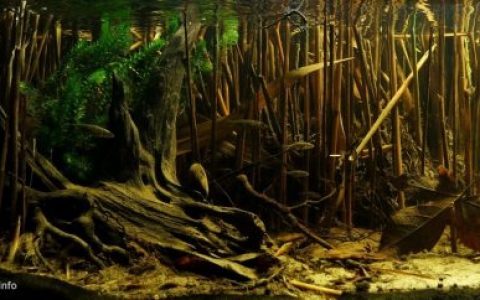
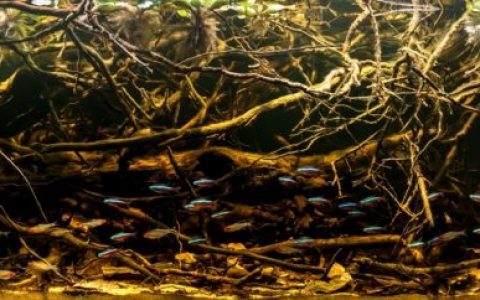
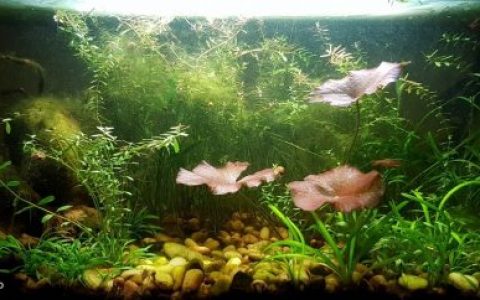
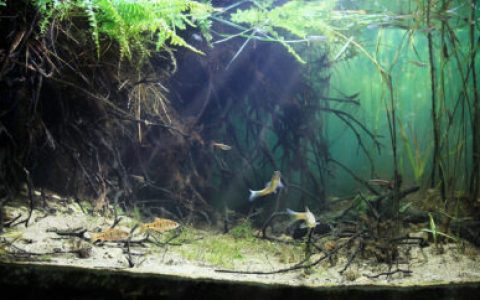
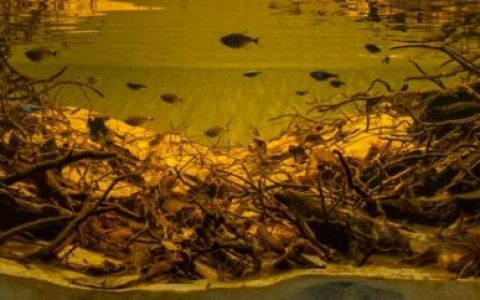
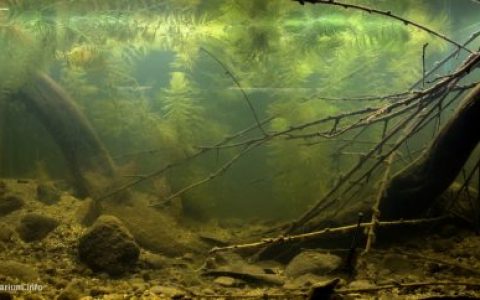
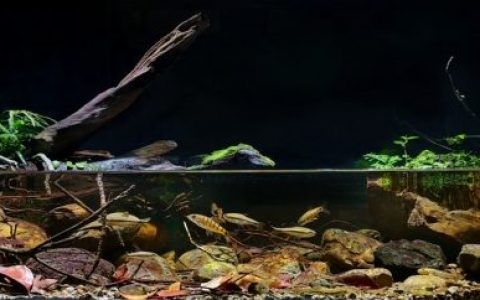
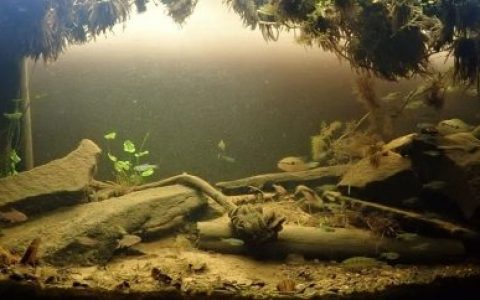
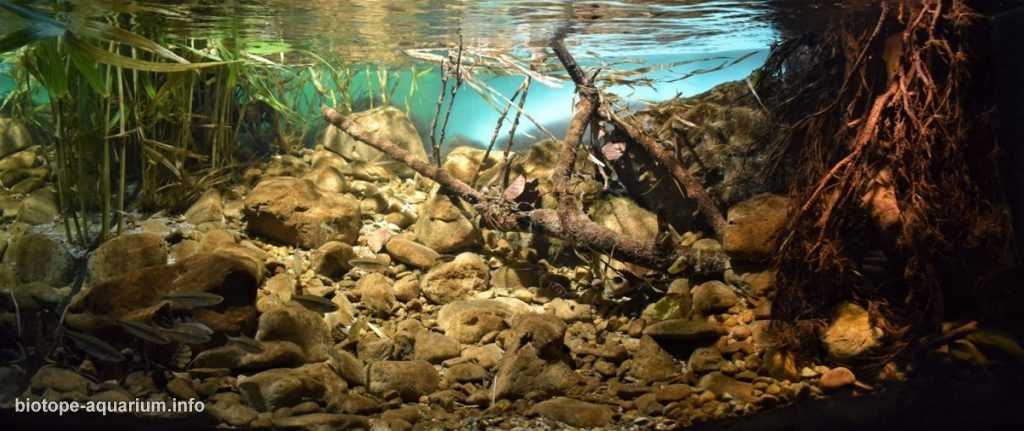
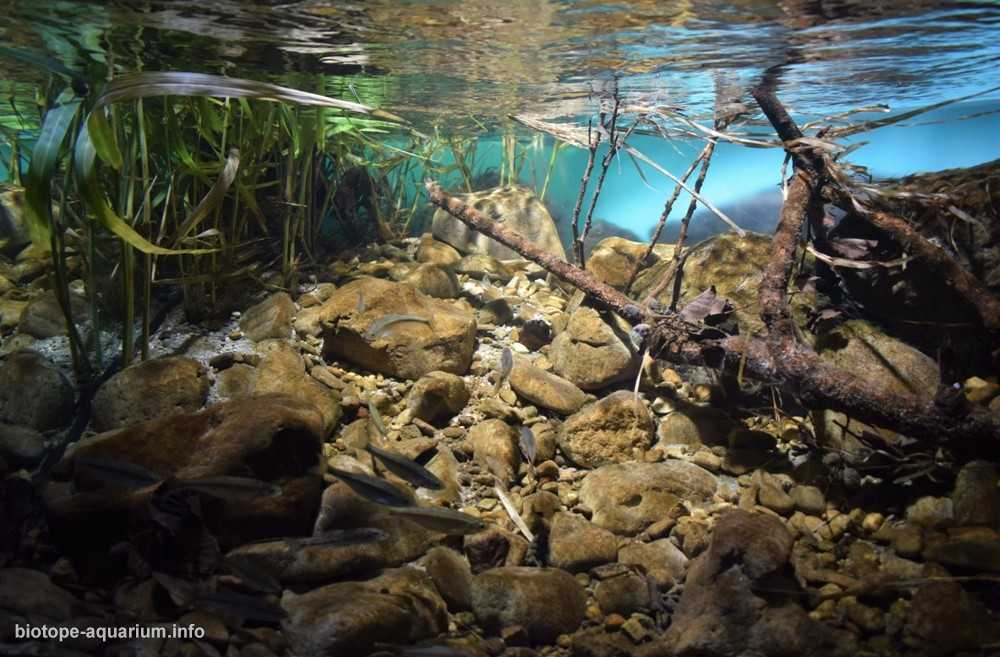
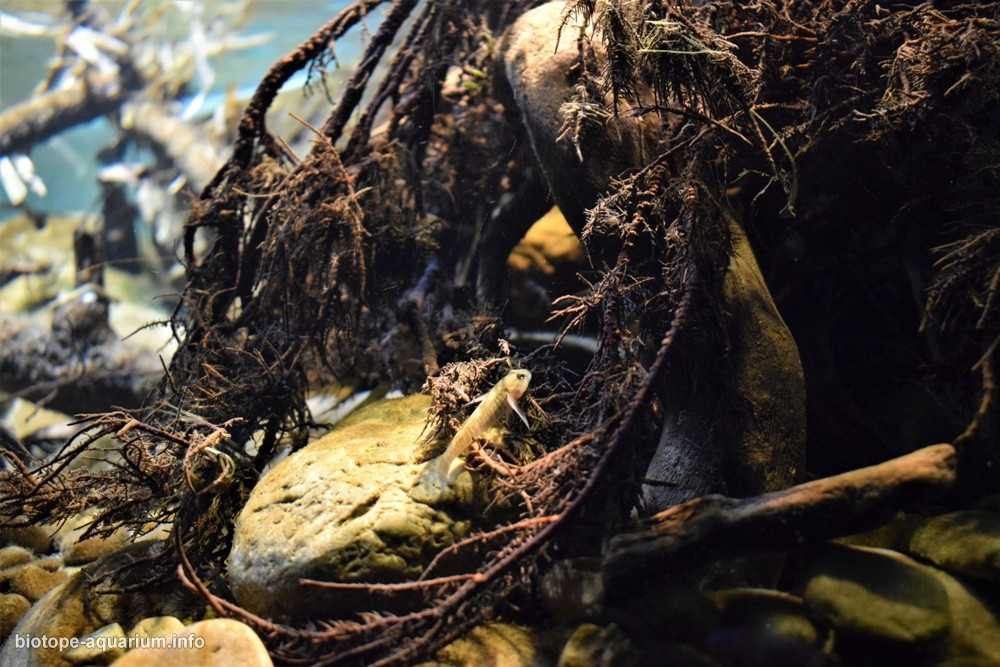
Description of decorations: The design of the biotope system has been implemented in a technique that I call “Deep Shadow”, it consists of placing the same elements that are also in the aquarium for a dry tank, stones, roots, reeds as in this biotope, as well as many other elements of soil arrangement. In addition, we can illuminate the background behind the aquarium with RGB LEDs, the bridge that connects the water part with the dry to the unity is a matt adhesive film. Aquarium simulates the beginning of the dry season and presents a stony stream bed located between two banks, on the left we have a reed island, which, like in nature, occurs on a silty or gravel bottom in places directly lit by the sun. There are plenty of crustaceans and algae in the reed habitats (that’s why the background from this site is green) is a great source of fish food. On the right side of the bank we can see the beautiful red alder roots washed out by the stream, which are a refuge for Cobite (caught there) and other small fish species. The stream bed is lined with stones of different sizes, gravel and sand, and at the bottom we can find alder cones so liked by aquarists. In the middle part of the stream there is a broken alder branch and to emphasize the dynamics of the biotope on the photos, in the reed I placed the 8000l / h pump and directed the water current to the sticks, the sediments themselves flow on the branch, giving the traffic biotope. In the dry season, the water is low, but very clean in terms of chemico-physical.All elements used in this aquarium, such as substrate, roots, branch, plants, stones, rocks and cones with fish once were collected from this biotope in nature and documented on the new website ExploreBiotope.com
装饰描述:生物群落系统的设计采用了我称之为“深影”的技术,它包括将干养缸中使用的相同元素放置在生物群落中,如石头、根系、芦苇等,以及许多其他土壤排列元素。此外,我们还可以用 RGB LED 照亮水族箱背后的背景,连接水生部分与干养部分的桥梁是一层哑光粘合膜。水族箱模拟了旱季的开始,展示了两河岸之间的一处石质溪床,左侧有一片芦苇岛,如同自然界中那样,在阳光直射的沙质或砾石底部形成。芦苇栖息地中有丰富的甲壳类动物和藻类(这就是为什么这个区域的背景是绿色的),是鱼类食物的绝佳来源。河岸右侧可以看到溪流冲刷出的美丽的红杨树根系,它们是 Cobite(在那里捕获)和其他小型鱼类物种的避难所。溪床铺满了不同大小的石头、砾石和沙子,底部还可以找到红杨树果,深受水族爱好者喜爱。 在溪流的中部有一段断裂的桤木枝,为了在照片中强调生物群落的动态,我在芦苇中放置了 8000 升/小时的泵,并将水流引向树枝,沉积物本身在树枝上流动,形成交通生物群落。在旱季,水位较低,但化学物理性质非常清洁。这个水族箱中使用的所有元素,如底床、根系、树枝、植物、石头、岩石和锥,以及鱼,曾经都是从自然界中收集的这种生物群落,并在新的网站 ExploreBiotope 上进行了记录。
Description of equipment: Filtration: JBL CristalProfi e1901 greenline – 1900l / h bucket capacity 15l divided into 5 baskets with media, one is a protective sponge, the other four is a biology divided between, Jbl Micromec balls and good quality sintered glass (ceramics).
设备描述:过滤:JBL CristalProfi e1901 绿线型——桶容量 15 升,分为 5 个带有介质的篮子,其中一个是保护性海绵,另外四个是生物学分类,包括 Jbl Micromec 球和优质烧结玻璃(陶瓷)。
Water circulation: Jebao DCP-8000l / h electronic pump
水循环:Jebao DCP-8000 升/小时电子泵
Light: The basic lighting is Aquatlantis Easy LED Freshwater, 1047mm, 6800 ° K-52w with EASY LED CONTROL, a simulator of the effects of sunrise and sunset. In addition, a 6000 ° K-16w led lamp, and a small 4000 ° K-10w led lamp, which simulates the sun’s rays piercing through the tree’s crown and illuminating the red alder’s roots. The matte self-adhesive foil was used to make the background, which was additionally illuminated with rgb ledges, on the left side where the reed grows I used a 40cm green rgb strip, it is supposed to simulate algae deep in the reed. The rest of the background is illuminated with rgb LEDs in light blue color which gives the overall depth of water.
光照:基础照明为 Aquatlantis Easy LED 淡水灯,1047 毫米,6800K-52W,配备 EASY LED CONTROL,模拟日出日落效果。此外,还有一盏 6000K-16W LED 灯,以及一盏小型的 4000K-10W LED 灯,模拟阳光穿透树冠照亮红杨的根系。背景使用磨砂自粘箔制作,并额外用 RGB 灯带照明。在生长芦苇的左侧,我使用了一卷 40 厘米长的绿色 RGB 灯带,用于模拟芦苇深处的水藻。背景其余部分用浅蓝色 RGB 灯带照明,营造出水的整体深度。
Water parameters: Temperature 25°C – PH 7,65 – NO2 0,00mg/l – NO3 10,00mg/l – KH°d 8 – GH°d 17
水质参数:温度 25°C – pH 7.65 – NO2 0.00mg/l – NO3 10.00mg/l – KH°d 8 – GH°d 17
Additional info: Water changes are 50% every 20 days, the fish are Wild and after catching and moving to the aquarium, they started eating on the second day, now feeding four times a day with JBL AutoFood, the fish get mosquito larvae too.
补充信息:每 20 天换水 50%,鱼是野生的,在捕捉并移入水族箱后第二天就开始进食,现在每天喂食四次,使用 JBL AutoFood,鱼也会吃蚊蚋幼虫。
INFORMATION ABOUT BIOTOPE
关于生物栖息地的信息
Description of the area surrounding the biotope: Zena is a mountain stream of the Central Bologna Apennines in the Gessi Bolognesi Regional Park and Calanchi dell’Abbadessa with its headquarters in San Lazzaro di Savena, which rises in the hills north of the ridge between Loiano and Quinzano 44 ° 15’18.25 “N 11 ° 20 ‘ 26.56 “E / 44 ° 25’50.69” N 11 ° 34’07.11 “E, at an altitude of 750 m above sea level. There are two sources: it is on the west side of the Bastia 792 m.s.lm mountain, and the eastern arm is near Quinzano. This last branch is the main in length and flow of water and creates a beautiful thirty-meter waterfall falling into the forested Quinzano gorge. This area has been documented the existence of hunting communities since the Paleolithic, Bronze Age and just behind the park of the Roman city of Claterna probably of Etruscan origin, developed in Republican times, and especially Augustinians surrounded by the crown of suburban villas, beautiful mosaic floors discovered during excavations are partly preserved today at the Archaeological Museum in Bologna. In the Middle Ages, entire territories were characterized by small villages scattered in the hills, generally fortified and centered around castles or churches. For example, the fortress of San Pietro di Ozzano comes from the inhabitants of Claterna who, after the destruction of the city in the fifth century, took shelter on a nearby hill. Starting from the thirteenth century, the use of baked plaster as a plaster gypsum was developed. The area of the park was affected by systematic chalk excavations, from numerous small quarries at the end of the 19th century, it went into mechanized activity, and then into industrial exploitation, with a great impact on the environment. Many caves were destroyed or their stability was irreversibly disturbed, as in the case of the Farneto cave near the reconstructed biotope. The area of the Park is 3,123 hectares, despite the extreme proximity of the urban area of San Lazzaro di Savena, the park is home to many species of flora and fauna. Zena stream is 40 km long and in its small basin it also receives water from small fields such as Rio di Gnazzano, Rio Laurenzano (main), Rio dei Cani, Rio di Barbarolo, Rio di Caldarano, Rio di Bianchini and Rio dei Vinchi, and then connects with the Idice stream and flows into the river Reno. Ecosystems of park sources and streams are as complex and diverse as onshore. The composition of water and soil are among the main factors determining the presence and distribution of plant and animal species. Transitional zones between the aquatic and terrestrial environments (ecotones, shelters) in which coastal vegetation is located represent the connection between the river and terrestrial ecosystem. There are many animal organisms in such characteristic environments, such as amphibians, reptiles, birds, as well as many mammals, which despite the fact that they do not live exclusively in water, survive thanks to its presence. In the environmental contexts of running waters, as in standing waters, we find vegetation cover characterized by species that exhibit specific and diverse morphological and ecological adaptations in terms of appearance, development and reproduction strategies. The most widespread and characteristic aspect of vegetation, which covers the river bed and streams, is the Salix sp. Willow, mainly made up of species with large shrubs and cuttings. Willows developed the ability to resist the current by implementing a number of adaptive strategies, such as the flexibility of stems and branches. In more calm bends of the river you can meet white willows, black poplar Populus nigra, and sometimes also alder Alnus sp. There are no real aquatic plants in the area (Hydrophytes that carry out the entire vegetative cycle in water). Water vegetation, which grows on wet areas and above all on gravelly or muddy bottoms with low water velocities, is characterized, in relation to the water depth, by habitats dominated by Phragmites australis reeds, typha beetroots Typha angustifolia and Thypa latifolia. In the streams stretching through the park, throughout the year, there are species characteristic of watercourses, such as the kingfisher Alcedo atthis, with characteristic colored plumage that hunts for small fish, diving into water from protruding branches. Along the stream and in the adjacent areas there are also bee eaters Merops apiaster, a small swallow also called the paradise bird. One of the most beautiful birds with a slim silhouette and pointed wings. Another species associated mainly with forested areas with mature trees along watercourses, difficult to observe, but easily detectable in summer thanks to singing, melodious Lio -io is oriolus Oriolus oriolus, whose male has a unique yellow color with black wings. There are many amphibians, reptiles and various species of mammals, such as vole, shrew and skunk, at the Zena stream, these species are closely related to water areas. There are also other species that go to drink or seek shelter. These include foxes, weasels, roe-deer and wild boars. The clear waters of the stream are full of fish. We find here Cobitis bilineata (Canestrini 1865), chub Leuciscus cephalus (Linneo, 1758), roach Chondrostoma genei (Bonaparte, 1839), Gobione europeo Gobio gobio (Linnaeus, 1758), Scazzone Cottus gobio, Cobitis taenia (Linneo, 1758). Cobane mascherato Sabanejevi larvata (De Filippi, 1859), Ghiozzo padano Padogobius bonelli (Bonaparte, 1846), Alburnus arborella (Bonaparte, 1841), trout and many other species, miraculously saved from the bending of Knipowitschia punctatissima and invasive Pseudorasbora parva, Exact coordinates location of the stream biotope is 44 ° 25’50.0 “N 11 ° 23’60.0” E on-site activities such as: water sample taken, temperature, environmental photos and underwater video were taken. The area of the Zena stream (both the valley and the entire pool), with its bucolic appearance, alternating with gentle hills with meadows and forests and some ravines and valleys, scattered buildings and rocky outcrops, has an almost intact nature with almost no production activity and modesty housing estates shows extraordinary natural and historical values.
该生物群落周边地区的描述:Zena 是博洛尼亚中部亚平宁山脉中的一条山溪,位于 Gessi Bolognesi 地区公园和 Abbadessa 峡谷,总部设在 San Lazzaro di Savena。它发源于 Loiano 和 Quinzano 山脊以北的丘陵地带,坐标为 44°15’18.25”N 11°20’26.56”E / 44°25’50.69”N 11°34’07.11”E,海拔 750 米。该溪流有两个源头:西侧位于海拔 792 米的 Bastia 山上,东侧分支靠近 Quinzano。最后一个分支是主要的,其长度和水量较大,形成了一个三十米高的瀑布,落入 Quinzano 的森林峡谷中。该地区自旧石器时代以来就有狩猎社区的记录,进入青铜时代,并在罗马城市 Claterna 的公园后面,可能具有伊特鲁里亚起源,在共和国时期发展,尤其是奥古斯丁时期,被郊区别墅的冠冕环绕,在挖掘过程中发现的精美马赛克地板,部分至今仍保存在博洛尼亚考古博物馆。 在中世纪,整个地区都由散布在山丘上的小村庄组成,这些村庄通常有防御设施,以城堡或教堂为中心。例如,圣彼得罗·迪·奥扎诺要塞来自克拉特纳的居民,他们在公元五世纪城市被摧毁后,躲藏到附近的山上。从十三世纪开始,使用烧制石膏作为石膏灰泥的做法得到发展。公园区域受到系统性的白垩矿开采影响,从十九世纪末的众多小型采石场,发展到了机械化活动,然后是工业开采,对环境产生了巨大影响。许多洞穴被摧毁或其稳定性被不可逆转地破坏,例如在重建生物群落附近的法内托洞穴。公园面积达 3,123 公顷,尽管与萨韦纳的城区非常接近,但公园是许多植物和动物物种的栖息地。 Zena 溪长 40 公里,其小流域还接纳来自 Gnazzano 小河、Laurenzano 河(主河)、Cani 河、Barbarolo 河、Caldarano 河、Bianchini 河和 Vinchi 河等小片田地的水,然后与 Idice 河相连,流入 Reno 河。公园源头和溪流的生态系统与陆地生态系统一样复杂多样。水和土壤的组成是决定植物和动物物种存在和分布的主要因素。水生和陆生环境之间的过渡区(生态交错带、避难所),其中分布着沿海植被,代表了河流与陆地生态系统的连接。在这样的特色环境中有许多动物生物体,如两栖动物、爬行动物、鸟类,以及许多哺乳动物,尽管它们并不完全生活在水中,但依靠其存在得以生存。在溪流的环境背景下,与静水环境一样,我们发现了以物种在形态、发展和繁殖策略方面表现出特定和多样化形态生态适应为特征的植被覆盖。 植被最广泛和最具特色的方面,覆盖着河床和溪流,是柳树属(Salix sp.)。柳树主要由大型灌木和插枝组成。柳树通过实施多种适应策略发展出抵抗水流的能力,例如茎和枝条的柔韧性。在河流较为平静的弯曲处,可以遇到白柳、黑杨(Populus nigra),有时也会有桤木(Alnus sp.)。该地区没有真正的水生植物(在水生环境中完成整个生长期的水生植物)。生长在潮湿地区,尤其是砾石或泥泞底部且水流较缓的水生植被,根据水深,以芦苇(Phragmites australis)、香蒲(Typha angustifolia)和宽叶香蒲(Thypa latifolia)为主。在公园内的溪流中,全年都有河流特有的物种,例如翠鸟(Alcedo atthis),其具有特征鲜明的彩色羽毛,从突出的树枝上俯冲入水捕食小鱼。 沿着溪流及其邻近区域,还有蜂鸟 Merops apiaster,一种小型燕子,也被称为天堂鸟。这是最美丽的鸟类之一,拥有苗条的轮廓和尖利的翅膀。另一种主要与成熟树木沿水道分布的森林区域相关的物种,难以观察,但在夏季容易通过其歌唱声——悦耳的 Lio -io 声音来识别,这是或黄鹂 Oriolus oriolus,雄性具有独特的黄色和黑色翅膀。在 Zena 溪流有许多两栖动物、爬行动物和各种哺乳动物,如田鼠、鼩鼱和臭鼬,这些物种与水域密切相关。还有其他前往饮水或寻找庇护的物种。包括狐狸、黄鼠狼、麋鹿和野猪。溪流清澈的水中充满了鱼类。我们在这里发现 Cobitis bilineata (Canestrini 1865)、鳊鱼 Leuciscus cephalus (Linneo, 1758)、鲫鱼 Chondrostoma genei (Bonaparte, 1839)、欧洲 Gobione Gobio gobio (Linnaeus, 1758)、Scazzone Cottus gobio、Cobitis taenia (Linneo, 1758)。 伪装的 Cobane Sabanejevi larvata(De Filippi, 1859)、Padano Ghiozzo Padogobius bonelli(Bonaparte, 1846)、Alburnus arborella(Bonaparte, 1841)、鳟鱼和许多其他物种,奇迹般地避开了 Knipowitschia punctatissima 的弯曲和外来 Pseudorasbora parva 的侵害,溪流生物栖息地的精确坐标为 44°25′50.0″N 11°23′60.0″E,现场活动包括:采集水样、测量温度、拍摄环境照片和水下视频。Zena 溪流区域(包括山谷和整个池塘),以其田园风光,交替出现温和的小山、草地和森林,以及一些峡谷和山谷,散布的建筑物和岩石露头,几乎未受破坏的自然环境,几乎没有生产活动,以及简朴的住宅区,展示了非凡的自然和历史价值。
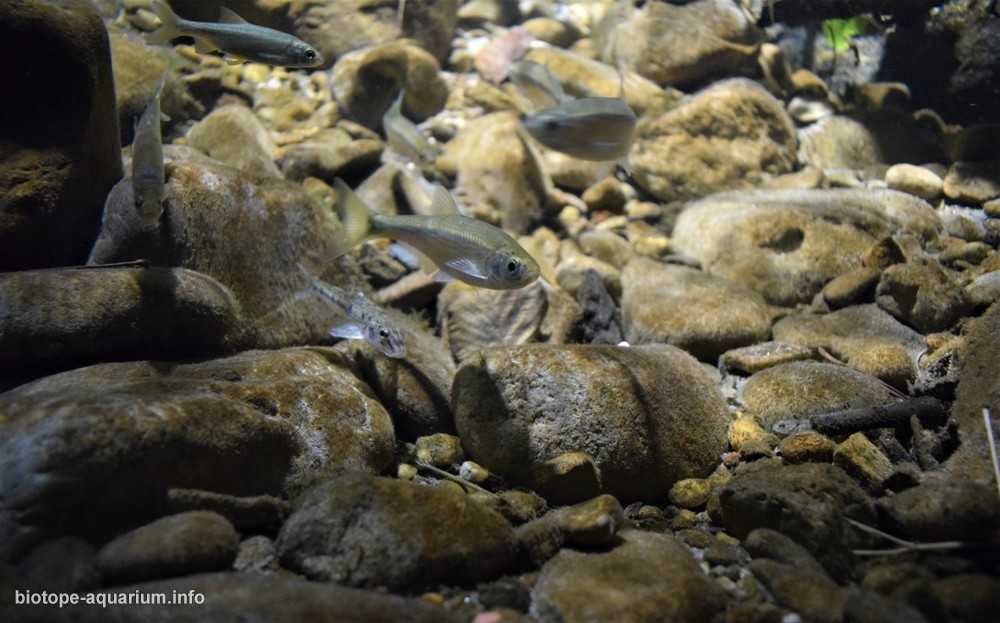
Description of the underwater landscape of the biotope: The Zena stream is 40 km long and its hydraulic regime is typical for Bologna streams and streams, maximum flow rates are 15 m³ / s during rainstorms, up to 2 m³ / s flow in spring, and average annual flow rates of 1 m³ / s. The transparency of water varies depending on the zones and the amount of rainfall, the summer water is very clean. The average depth of the stream is from 20 cm at the end of August to 150 cm in winter. The stream’s surface consists mainly of various sizes of sandstones and pebbles, and the edges of the trough carved in the area alternate from wooded, overgrown with reeds, which like the sun for habitats, choose the area without trees. Often we can also find invading bamboo colonies, there are no plants in the biotope.
对生物群落水下景观的描述:Zena 溪长 40 公里,其水文状况具有博洛尼亚溪流的典型特征,暴雨时最大流量为 15 立方米/秒,春季流量高达 2 立方米/秒,年平均流量为 1 立方米/秒。水的透明度因区域和降雨量而异,夏季水非常清澈。溪流的平均深度从 8 月末的 20 厘米到冬季的 150 厘米。溪流表面主要由不同大小的砂岩和鹅卵石构成,而凹槽边缘则交替出现林地、芦苇丛生的区域,这些区域喜欢阳光,选择没有树木的地方作为栖息地。我们经常还能发现入侵的竹子群落,生物群落中没有植物。
Description of the parameters of the habitat: Summer temperature 22°C/ 29°C – PH 7,88 – NO2 0,00mg/l – NO3 0,00mg/l – KH°d 9 – GH°d 18
栖息地参数描述:夏季温度 22°C/ 29°C – pH 7,88 – NO2 0,00mg/l – NO3 0,00mg/l – KH°d 9 – GH°d 18
List of fishes and invertebrates occurring in the nature biotope: Alburnus arborella (Bonaparte, 1841), Cobitis bilineata (Canestrini 1865), Gobio gobio (Linnaeus, 1758), Padogobius bonelli (Bonaparte, 1846), Knipowitschia punctatissima, Pseudorasbora parva.
自然生物群落中出现的鱼类和无脊椎动物清单:Alburnus arborella (Bonaparte, 1841), Cobitis bilineata (Canestrini 1865), Gobio gobio (Linnaeus, 1758), Padogobius bonelli (Bonaparte, 1846), Knipowitschia punctatissima, Pseudorasbora parva。
Leuciscus cephalus (Linneo, 1758), Chondrostoma genei (Bonaparte, 1839), Cottus gobio, Cobitis taenia (Linneo, 1758). Sabanejewia larvata (De Filippi, 1859)
Leuciscus cephalus (Linneo, 1758), Chondrostoma genei (Bonaparte, 1839), Cottus gobio, Cobitis taenia (Linneo, 1758)。 Sabanejewia larvata (De Filippi, 1859)
List of plants found in the nature biotope: Phragmites australis, Typha angustifolia, Thypa latifolia. Tree: Alder alnus roots, branches, leaves and cones were used to decorate the biotope.
自然生物群落中发现的植物列表:芦苇、狭叶香蒲、宽叶香蒲。树木:使用桤木的根、枝条、叶子和松果来装饰生物群落。
Threats to the ecology: In 2013, a detailed report on the water environment of the region was prepared, in which the Zen stream was also described. The whole document is in a PDF file, which I placed in the link, I emphasize that I have never met such a detailed study so far, which took scientists a good few years. The system of standards that regulates the water sector at both European and national levels has radically changed in recent years under the pressure of awareness of the depletion of water resources and is increasingly focused on sustainable development and on one integrated water resource management. The last goal of this EWOLUTION is the 2000/60 / CE Water Directive, which states at the outset that “water is not a commercial product equal to another, but a HERITAGE that must be protected, defended and treated as such” and defines it as “state surface water “general expression determined by the lowest value of ecological status and chemical state, which are combined in the study. The same UNIVERSAL DECLARATION OF HUMAN RIGHTS (article 25) states that WATER is a necessary element to ensure everyone’s universal human right “up to a level sufficient to live and guarantee the health and well-being of their own and their own family.” The main innovative aspect of the new Environmental Status Directive It is achieved by studying the flora and fauna communities that inhabit watercourses, as well as specific contamination of physicochemical elements, etc. There are also problems related to the management of rivers and streams. Controversy in the summer of 2014 Concerning cutting down trees in Savena and on Zena showed lack of knowledge in this delicate and uniform vision of good or bad interventions to be carried out in rivers. Together with climate change, the risk of floods, landslides and total river rains is increasing This is why it is important for this problem to be considered with attention for the future. The carried out research shows that the Zen stream has a very high ecological status and kept all its original values, and this mainly contributed to the survival of species ichthyofauna. Knipowitschia punctatissima (Panzarolo) is a small grandmother with very limited dimensions from 4 to 5 centimeters in length. It occurs endemically in northern Italy, Friuli, Veneto, Lombardy and Emilia Romagna, gender is distinguished by color, males have a spot on the first dorsal fin, in the reproductive period they have a yellow abdominal area. Knipowitschia punctatissima occur in an environment with clean and well-oxygenated water, with medium current, inhabited by stony, sandy and gravel bottoms full of hiding places. Reproduction begins from February to June, where several females can sit in the same nest and wait for the male to fertilize, and continue to look after it for 10 days until hatching. In general, there is no information about the behavior of this small fish, after a monthly observation in the aquarium, I can say that it is a very territorial species. Males share in the areas and in each of them there must be a hideout (nest), fish swim specifically from stone to stone, often stop at the top and observe the surroundings, very spontaneously react to possible aggressors, even two times bigger than themselves. The population is seriously threatened by anthropic pressure so much that IUCN considers it a CRITICAL DANGEROUS (critical risk of total extinction). Extreme pollution, habitat changes, lowering aquifers, urbanization and the basin reduce populations, and if this is not enough, few surviving fish are isolated and cross between themselves (between relatives), the number of specimens is getting smaller and smaller. The main reason is that this species lives in very clean waters, such as springs and streams, in habitats. A few years ago ichthyologists were worried about the fate of this delicate fish. In 2002, because of the strong heat wave and drought, all sources were dry for about 8 months. Panzarolo lives in waters with a temperature of about 15/25 ° C, eight-month drought and high temperatures led the scholars to believe that Panzarolo was extinct. In 2003, no trace of him was found after some research. Then, after one year, they were pleasantly surprised, and Knipowitschia punctatissima was found again. And since 2005 Panzarolo has returned to inhabited sources. How did such a small delicate fish survive? Armando Piccinini and his colleagues have not yet found a definite explanation: the only hypothesis is that they managed to reach some of the underground Roman pipelines that could be in the area where the water remained. It also happens that the Zen stream dries out during the dry season, sometimes a month or two are completely without water, and here the question arises, what about the fish? Species such as Alborella, are known to migrate down the stream as the temperature increases, looking for habitats with deeper water. But what about Gobidae? After all, they are not good swimmers, or maybe the stream has also underground tributaries or flooded caves ex-mines, which we do not lack in the area, we also know that Knipowitschia punctatissima leads the night life and this hypothesis could be probable. I’ve been thinking about it for two months now, but for now, it’s just the opinion of a crazy aquarist and maybe thanks to the presentation of this aquarium, there will be someone specialized who will guess the riddle and prove how it really is.
生态威胁:2013 年,一份关于该地区水环境的详细报告被编制出来,其中也描述了 Zen 溪流。整份文件以 PDF 格式保存,我已将其放在链接中,我强调这是我至今从未见过如此详细的研究,科学家们花费了数年时间完成。在水资源枯竭意识的压力下,近年来,欧洲和国家层面的水行业标准体系发生了根本性变化,越来越关注可持续发展以及综合水资源管理。EWOLUTION 的最终目标是 2000/60/CE 水指令,该指令开宗明义地指出“水不是与其他商品相等的商业产品,而是一种必须加以保护、捍卫并如此对待的遗产”,并将其定义为“由生态状态和化学状态中最低值确定的‘一般地表水’这一通用表述,这些都在研究中得到结合”。 同样的《世界人权宣言》(第 25 条)指出,水是确保每个人享有“足以维持生活和保障其自身及家庭成员健康和福祉”这一普遍人权的必要要素。新《环境状况指令》的主要创新方面是通过研究栖息于水道的植物和动物群落,以及特定物理化学元素的污染等来实现。此外,还涉及河流和溪流管理方面的问题。2014 年夏季关于萨韦纳和泽纳砍伐树木的争议表明,在河流进行良好或不良干预的敏感且统一的观念上存在知识缺乏。随着气候变化,洪水、滑坡和全面河流降雨的风险正在增加,因此,未来需要对此问题予以重视。所进行的研究表明,泽纳溪流具有非常高的生态状况,并保持了其所有原始价值,这主要促成了鱼类动物群落的生存。 Knipowitschia punctatissima (Panzarolo)是一种体型非常小的鱼,体长仅 4 至 5 厘米。它仅分布于意大利北部,包括弗留利、威尼托、伦巴第和艾米利亚-罗马涅地区。该物种的性别可通过颜色区分,雄鱼在第一背鳍上有斑点,在繁殖期腹部呈黄色。Knipowitschia punctatissima 生活在清洁且溶氧充足的水域,水流适中,栖息于布满藏身之处的石质、沙质和砾石底床。繁殖期从 2 月至 6 月,数条雌鱼会共同占据同一巢穴,等待雄鱼进行受精,并在孵化前继续守护 10 天。关于这种小型鱼类的行为,目前尚无明确信息。经过在鱼缸中的月度观察,我可以确认它是一种极具领地意识的物种。雄鱼会共享区域,每个区域都必须有一个藏身之处(巢穴),鱼儿会专门从一块石头游到另一块石头,经常停留在顶端观察周围环境,对可能出现的入侵者反应非常迅速,即使对方体型是自己两倍大也不例外。 该物种因人为压力而面临严重威胁,以至于 IUCN 将其列为极度濒危(面临完全灭绝的临界风险)。极端污染、栖息地变化、含水层下降、城市化和流域减少种群数量,如果还不够,少数幸存的鱼被隔离并相互交配(在亲属之间),物种数量越来越小。主要原因在于这种物种生活在非常清洁的水域,如泉水和溪流中。几年前,鱼类学家们担心这种娇嫩的鱼的命运。2002 年,由于强烈的热浪和干旱,所有水源干涸了约 8 个月。Panzarolo 生活在约 15/25°C 的水域中,8 个月的干旱和高温使学者们认为 Panzarolo 已经灭绝。2003 年,经过一些研究后,没有发现它的踪迹。然后,一年后,他们惊喜地发现,Knipowitschia punctatissima 又出现了。自 2005 年以来,Panzarolo 重新回到了有生命的源头。这样一个小而娇嫩的鱼是如何生存下来的? 阿曼多·皮奇尼尼和他的同事们尚未找到确切的解释:唯一的假设是他们成功到达了部分地下罗马管道,这些管道可能位于水位保持的区域。巧合的是,泽纳溪在旱季会干涸,有时一个月或两个月完全没有水,这时问题就来了,鱼怎么办?像阿尔博雷拉这样的物种,在温度升高时会顺流而下,寻找更深的水域栖息地。但戈比亚科呢?毕竟它们不是很好的游泳者,或者也许溪流也有地下支流或被淹没的矿井,我们这一带并不缺乏这些,我们还知道尼普沃茨基亚·点状体主导着夜间活动,这个假设可能是合理的。我已经思考了两个月了,但目前这只是疯狂水族爱好者的观点,也许感谢这个水族馆的展示,会有专业人士猜出谜题,并证明实际情况究竟如何。
本文部分素材来自网络,如有类似请联系修改,如若转载,请注明出处:http://www.yangyubang.com/?p=2428